Although digital dating has started to take a backseat in recent years with college students, with up to 79% of undergraduate and graduate students saying they don’t use dating apps in a 2023 study, the experiences still exist.
That’s what WCU Assistant Professor in Psychology Meghan Gangel and Associate Professor in Communication Melinda Weathers, are observing in their grant-funded research project, Assessing College Students’ Worst Experiences of Digital Dating Abuse. The project was presented at the 2025 Research and Scholarship Conference at WCU in March by their two student research assistants, Ashley Elliott and Hannah Huddleston.
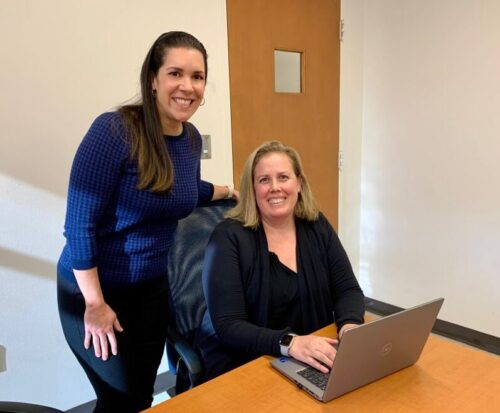
The research has also been shown at international conferences by Weathers. Her and Gangel have been working on this research for the past year and Elliott and Huddleston have been their research assistants for this semester. They received the Provost’s Scholarship Development Award in 2023 and Weathers has a journal article published in 2019 about digital dating abuse. She has had a passion for this field of research.
“My research program on digital dating abuse has developed from my interests in health communication, interpersonal relationships and new communication technologies,” Weathers said. “My recent work aims to better understand college student’s perceptions of digital dating abuse.”
Although dating apps like Tinder and Bumble seem to be on the decline when it comes to student usage according to Axios, a majority of students are still online in some way. Research shows that 100% of college students are internet users. In their current study Weathers and Gangel and their students are examining college students’ perception of their worst digital dating experiences.
They conducted an open survey of 600 undergraduate students from courses, the Sona System, campus posters and online postings. 249 of those students cited personal experiences they’ve had, and 66% of those were women. The experiences are coded into eight categories: direct personal attack, nonconsensual media, cheating, pressure, inappropriate messages, monitoring and control behaviors, physical violence and unpleasant experiences.
The top three offenses recorded in the survey were direct personal attacks (142 actions), pressure (42 actions), and nonconsensual media (34 actions). Direct personal attacks is a broad category that includes experiences that “hurt an individual’s character or self-perception in a way that causes internal distress to the recipient” such as degradation, blaming, and gaslighting. Pressure is “an action or communication to get an individual to do something they might not otherwise want to do,” such as blackmailing, coercion, and pressure for nude photos. Nonconsensual media is the “photographing or recording of an individual or sharing of such content without their consent,” and the reported actions included both media capture and media sharing.
The average age of the population when these incidents would occur to them was 17 years old, and the age ranged from 13 to 24 years old. When asked who initiated the incident, 209 responses were a dating partner, and when asked what they did about it when it happened, the responses are vast. They were asked to click all that apply on a list of reactions, and the most popular choices were that they were upset/sad, they cried, or they tried to talk to their partner about the incident. Other responses were ending the relationship, blocking their socials, or even laughing about it.
Most of the people who took the survey said they told a friend, a parent, or another member of their family, but another popular answer is that they told no one. In fact, more people told no one (44), than people who told a counselor (24). 214 of the responses identified their experience as either slightly abusive, abusive, or very abusive.
“What Dr. Gangel and I did, we really wanted to get at that idea of perception,” Weathers said in an interview. “What do college students think about these behaviors that we know are happening and we know are causing harmful effects.”
Elliott, who is a Communication major concentrating in Health Communication, is very interested in the research and has learned a lot through this project.
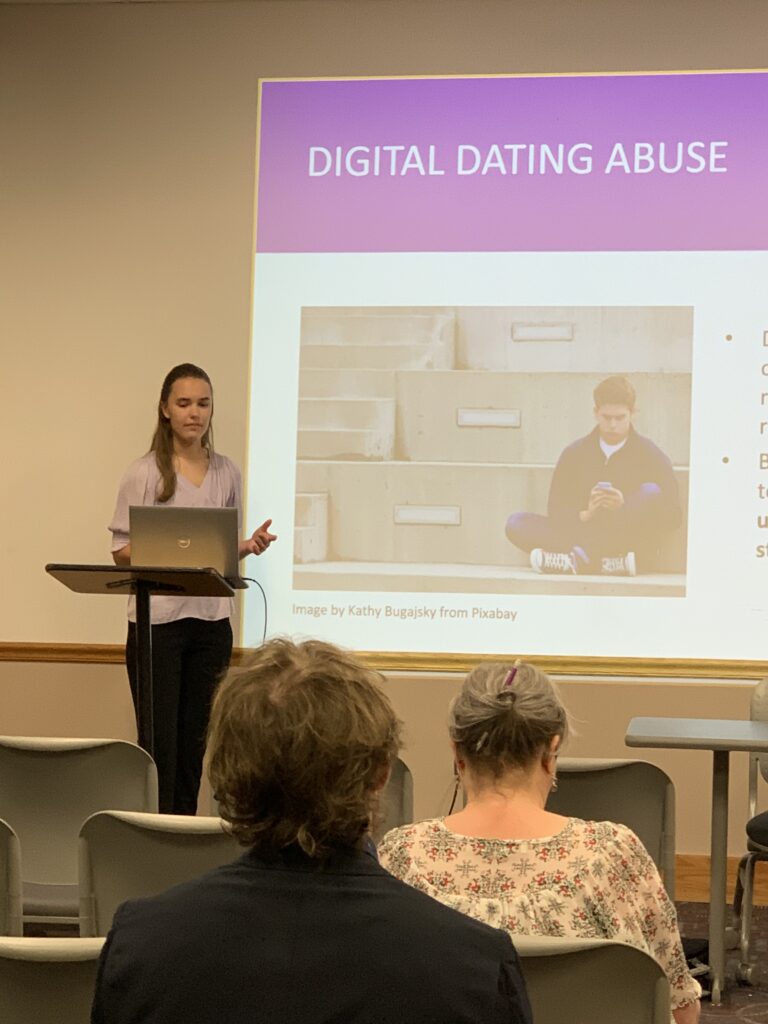
“Reading many of the qualitative responses was quite disheartening,” Elliott said. “Prior to doing this research, I had no idea just how prevalent and severe this issue was among my peers. Bringing light to this issue and understanding the nuances of what is occurring will allow for tailored interventions that can effectively and efficiently address DDA.”
The research is geared to understand how students deal with the abusive situations that can occur with digital dating, which is ever on the rise with the continued reliance of cell phones among the younger generation. The group hopes to increase awareness for these types of situations, and to let others know that they aren’t alone.
“I wonder if there may be some things they’re (students) are overlooking,” Gangel said in an interview. “Maybe they’re like ‘it’s not a big deal because they love me, they’re doing this in love’, and it’s not until it gets worse or the relationship dissolves and suddenly you have your girlfriends going ‘he was awful’ or ‘you were in an awful, toxic relationship’ and then you finally have a perspective to say that the victimization was happening and you just couldn’t see it.”
Gangel said that their goal is to use this information for some kind of prevention or intervention. “We would have students coming into college and we would say ‘hey, this is what relationships look like, and while you don’t think this behavior is a big deal, it is’ or we could create a tool where you go to an app and you describe the relationship and ask if that’s okay or should I talk to someone, which the app could direct them to resources at that point,” Gangel continued.
To hear more in-depth conversation about their research, listen this segment in episode three of WheeLife where I talk to Dr. Weathers and Dr. Gangel about the study and what they hope to accomplish with it.