“AI may not take your job, but the person who knows how to use it is,” said Kyla Parks, a construction management major at WCU.
Parks talks about how in her field utilizing AI as a constructive tool is useful for safety purposes and that it’s not a replacement for the work in her field.
“When people talk about it, they’re always talking about being scared that it’s going to take people’s jobs, but it’s more in a way to maintain site safety and monitoring, which decreases like time for other people, which sounds bad, but it makes projects more efficient,” Parks said.
Parks shares that in her classes AI isn’t utilized enough. She says that it is talked about in class in how it can be used in the field, but doesn’t get hands on experience with AI unless she is in an internship.
Business major, Izzy Smoyer, also talks about how her entrepreneur classes even encourage using AI to boost productivity.
“Our professor asked us to use them for our logo and motto making in my entrepreneurship class and just to help us get ideas for branding,” said Smoyer. “You can use AI and whatever generator to make our logos, make our mottos and titles. Our focus isn’t actually making the actual logo, it’s on starting up the business and using the finances. [Making logos] would just take a lot of time otherwise.”
Students in the engineering department also claim to utilize AI in a constructive way, but have asked to remain anonymous since AI is not explicitly encouraged.
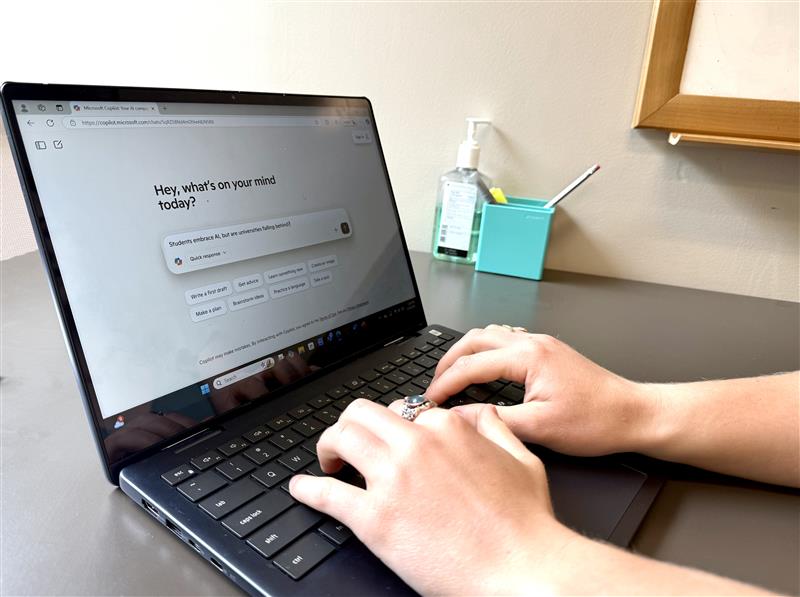
As AI becomes more common, WCU’s Faculty Senate this semester also weighs in on the implications of its use. WCU is trying to balance a way to positively utilize AI as a tool, while not jeopardizing academic integrity.
A national survey of higher education leaders conducted at the end of 2024 by the American Association of Colleges & Universities (AAC&U) and Elon University’s Imagining the Digital Future Center shows disparity in use of GenAI in academia.
The survey on AI includes feedback from over 300 university presidents, chancellors, provosts, rectors, academic affairs vice presidents, and academic deans.
56% say their institutions are not ready to prepare students for a future where AI plays a significant role.
53% believe their faculty lack the training to effectively use AI for teaching.
63% feel non-faculty staff are unprepared to incorporate AI into their work.
59% of the leaders say that graduates from last spring were not ready for jobs requiring AI skills.
89% of education leaders estimate that at least half of students use AI for coursework.
59% report that cheating has increased since AI became widespread and 21% say it has increased significantly.
62% of leaders said that less than half of faculty members actively use AI.
These findings indicate that there remains a gap between the high usage of AI from students and the appropriate directions from schools on how to use it in a productive way.
WCU AI Governance Committee representatives, the director of the School of Accounting, Finance, Information Systems, and Business Law, Ken Sanney and Ian Selig WCU IT learning technology presented at the Faculty Senate meeting in February
“There is a supply and demand in the labor market,” Sanney said during the presentation in front of the Faculty Senate. “We’ve got a problem with supplying demand; we have trust issues and then we have data and security issues. Our goal today is to show you how WCU has worked to close the gap between the uncertainty and the opportunity.”
Sanney and Selig provided updates on the policies that were updated to include language concerning new technologies, data on the use of Copilot as a tool by faculty and staff which was approved at the end of the fall of last year. This group will provide further recommendations for the university leadership to get the faculty and students better prepared for use of artificial intelligence as a tool to do better and faster work, not cheat. See the full presentation.
“I’ve only have ever had one professor that had us to use AI for an assignment, and I feel like, in a sense, it kind of makes students dependent on it. Once they try it for the first time, they’re going to want to keep doing it. I feel like it can be useful for some things, but there’s just an overreliance” said Delaney Rivers, a student studying sociology at WCU.
Rivers worries that AI can be used in the wrong way and that it may prevent students from really learning.
Dylan Branscome contributed to the story