Research at Richland Creek watershed, a head water way that flows through Waynesville, has been found of nine micro plastic particles per liter, which for a perspective is about 20 particles in a 2-liter bottle. Microplastics are classified as a “contaminant of emerging concern,” meaning that being exposed to low levels over long periods of time could become harmful to animals and even humans.
Microbead-Free Waters Act prohibits the manufacturing, packaging, distributing and selling of rinse-off cosmetic products, according to Compliance Gate. However, there is currently no approved limit for microplastics by the government as research on their impact is still ongoing.

Jerry Miller, a professor at WCU focusing on water resource management, has conducted research at Highlands Biological Station and Richland Creek watershed. One impactful finding is that there are more microplastic particles present in the water at higher elevations because of a higher concentration of microplastics in the atmosphere.
Miller began research in 2017-2018, with two different externally funded contracts. The grants funded a laboratory to analyze water samples and start testing for microplastics.
So, what are microplastics and why should you care?
Microplastics are a plastic polymer that is less than 5mm in size, these are about the size of a sesame seed and can be visible to the naked eye. These plastics then separate into even smaller particles called nano particles that are approximately one micron, for perspective a strand of human hair is about 70 microns thick, so these require powerful microscopes to be seen. Many of these plastic fibers come from clothing, such as polyester or nylon. These fibers break down from larger products and are things used in everyday life.
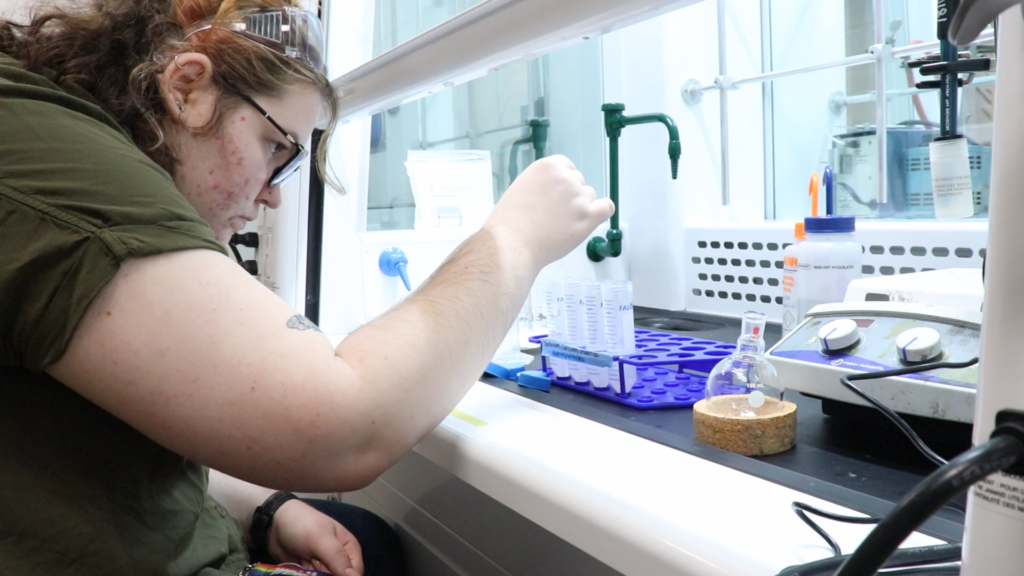
“They are generally not toxic in it of themselves, and there are some exceptions like polyvinylchloride that we use for pipes and things. That is the final chloride to a toxic chemical, but a lot of them are not. What is potentially toxic is when they put things in that we call an additive and this is what gives the plastic it’s overall characteristics, things like color and how fast they might weather in the environment,” said Miller.
Microplastics have even been found in human blood and human brain tissue samples thanks to research at the University of New Mexico Health Sciences. Research consisted of taking a sample collection from autopsies and then chemically dissolving it into a liquid mixture. A machine called a centrifuge separated plastic particles from the mixture. The plastics were then heated to release gas and are then viewed under a microscope.
“What we’re looking at is particles down to about 50 µm in size so from the size of a black ant down to about the size of a typical bacteria,” said Miller. “Nano plastics are even smaller than that, and they can cross kind of the cell wall. That’s what we’re primarily finding in human tissue, so it’s been found in a lot of human tissues organs. We just don’t know if it’s actually having a negative impact or not.”

The concentration of microplastics increases as you get more industrial and housing development. Atmospheric deposition along with plastics from various places, local and otherwise, are also contributors.
Miller emphasizes that technology for these findings has just now developed, so new findings are still coming out about the impact microplastics can have long term.
Tommy Moyer, a parks and recreation management major at WCU, shares his findings from online research on microplastics.
“Once absorbed, microplastics cause oxidative stress in the human body which can lead to cancer. They also stay in our reproductive organs which causes damage to them,” Moyer said.
Microplastics are everywhere, but some are more easily mitigated. Wastewater treatment plants can miss some fibers, so one method of mitigation is to improve these facilities. Many studies in the works are trying to find a way make these systems more efficient.
Miller did a study with large pieces of plastic debris and found that three dominant types were single use plastic bags, food wrappers and textiles. Keeping plastic out of the stream is helpful for reducing concentration, specifically with single use plastics. Additionally, some companies are trying to be proactive by creating biodegradable additives, while others are trying to get rid of additives altogether. If additives can be left out or mitigated, it can help prevent rivers, and us, from becoming toxic.