Version of the story was published in The Sylva Herald, Sept. 10 edition.
Western Carolina students might walk past the small sweetgum sapling near the front of campus without any idea how unique it is. This small tree’s seed has left the planet and orbited around the moon.

The Moon Tree, donated to the school by NASA Spring of 2024, was one of many seeds onboard the 2022 Artemis I mission when it orbited around the moon. The mission was similar to the Apollo 14 mission that brought seeds to the moon and back and distributed them around the U.S.
The seed was part of a project meant to distribute these “Moon Trees” around the country in an effort to inspire outreach and education on forestry and space exploration.
“It’s a way of bringing space closer to people who might not otherwise feel connected to it,” Amy Fagan, lunar geologist and professor and department head of Geosciences and Natural Resource program at WCU, said. “They wanted these trees to go to places where people don’t usually have access to NASA resources.”
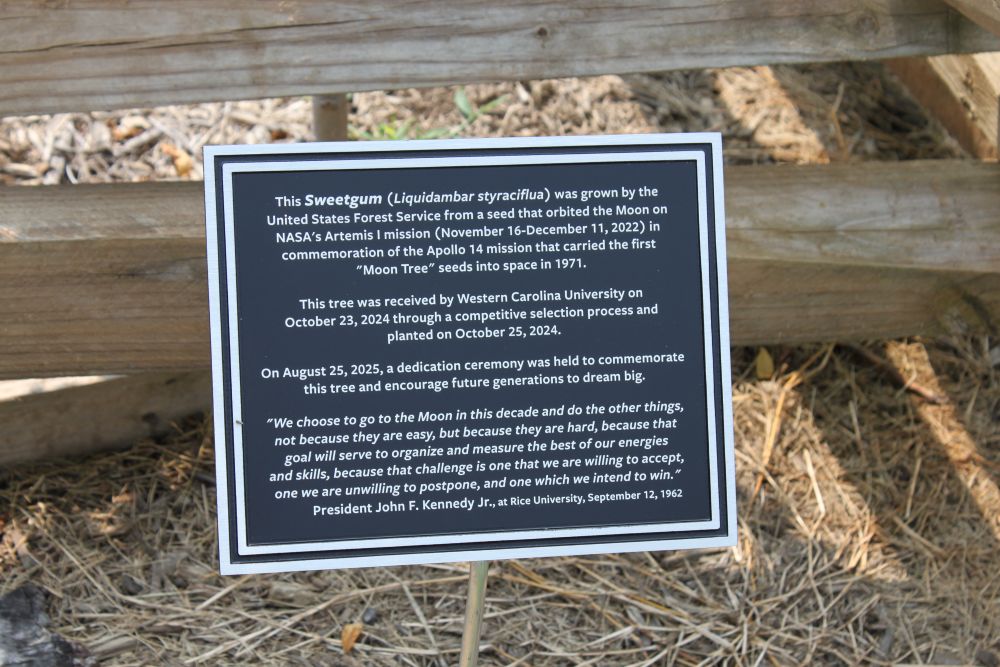
Located in the Cullowhee Creek Corridor, the tree is planted in a designated non-development area in the university’s master plan. Long-term protection is ensured for the tree here, and a protective fence was placed around it. The Geosciences & Natural Resources Department is responsible for its ongoing care.
Fagan learned about NASA’s Moon Tree program through various NASA affiliated mailing lists. She gained permission from the school to submit WCU as an applicant for the program, highlighting WCU’s Tree Campus USA designation and ensuring the tree would be protected.
“Luckily, our arborist is also a student in the department,” Fagan said, referring to Andrew Thigpen, a certified master arborist. “So I know it’s in very good hands.”
The Moon Tree is a sweetgum tree, one of five tree species NASA selected depending on regional climates. NASA picks trees based on what would thrive in local climates.
A dedication ceremony for the tree took place this Fall semester after it was postponed from its original date in August of 2024 due to weather. With full seats, there was only standing room left under the tent for the ceremony.
“It actually worked out perfectly,” Fagan said. “The weather was better, and the tree had its full canopy. Plus, everyone’s more excited at the start of the school year.”
Fagan is part of a NASA-led initiative called DIMPLE (Dating an Irregular Mare Patch with a Lunar Explorer), a $50 million project aimed at investigating the Ina Irregular Mare Patch on the Moon. Mare Patches are large, dark, basaltic plains on Earth’s Moon, formed by lava flowing into ancient impact basins. Fagan’s role involves developing instruments to analyze lunar rocks for signs of recent volcanic activity, using specialized cameras and a radioisotopic dating tool. Fagan has also contributed to astronaut simulations for lunar surface exploration and served on multiple NASA science panels, including the Lunar Exploration Analysis Group.
Fagan hopes to use the tree in the future as a platform for educational engagement, hosting events on days like International Observe the Moon night in October, and possibly running social media on the tree. She also hopes to one day start a side project to propagate as she liked to call them, “daughters of the Moon Tree,” saplings to grow from the original Moon Tree.
As the tree’s seed was not in space long enough to experience any serious radiation exposure, it should grow like any other sweetgum tree. It is not being used for research, though NASA periodically checks up on how the Moon Tree is doing.
For those with the WCUTrees app, an application used for mapping out and identifying trees on campus, the Moon Tree is not yet uploaded due to updates. However, users can view the tree on WCU’s web browser version of the campus tree app.