Story originally published in The Sylva Herald, Oct. 8 edition
Over the summer, the North Carolina General Assembly passed a bill that mandates all local boards of education create a phone policy for their districts.
NC House Bill 959, approved on July 1, includes the minimum standards for these phone policies. This includes limiting student access to age-appropriate content, protecting student safety in electronic communication and prohibiting social media use unless explicitly permitted by a teacher.
“The governing body of a public school unit shall establish a wireless communication policy,” Section 3 (a)(b) said. “The policy shall prohibit students from using, display or having a wireless communication device turned on during instructional time.”
The bill does allow for phone use in specific situations such as an emergency, educational purposes or as a part of a student’s individualized education program or 504 plan.
Boards need to adapt to these sections of the bill by Jan. 1, 2026.
Schools also must include social media and internet literacy skills in the curriculum that covers “its effect on health, including social, emotional and physical effects.” This addition does not have to be included in schools until the 2026-2027 academic year.
“We are following the legislation and were already in a good place when the law was passed. Most parents are in favor of this but, as with any change, some do not agree,” said Jackson County Public Schools superintendent Dana Ayers in an email.
At JCPS, each principal can implement a unique phone policy, as long as it meets the minimum state requirements.
“Students are permitted to possess cellular phones and other wireless communication devices on school property as long as such devices are not activated, used, displayed or visible during the instructional day or as otherwise directed by local school rules or school personnel,” the JCPS policy code 4318 says.
At Smoky Mountain High School, not much has changed with this new bill. Teachers are widely still in charge of their individual classroom phone policy.
“Nobody talked to us about phone use in the school. It is up to the teachers to tell us and only the English teacher asked us to leave the phones during the class on a side table. Some people do leave it, some don’t,” SMHS senior Aljosha Rusi said. “It is not like it is a known thing. I just know that they can take your phone or send you to the office. They [school] are a little stricter but not a lot.”
On the other hand, The Catamount School implemented a new phone policy that went into effect at the beginning of the semester. This middle school took on a more restrictive stance, but it has been well received.
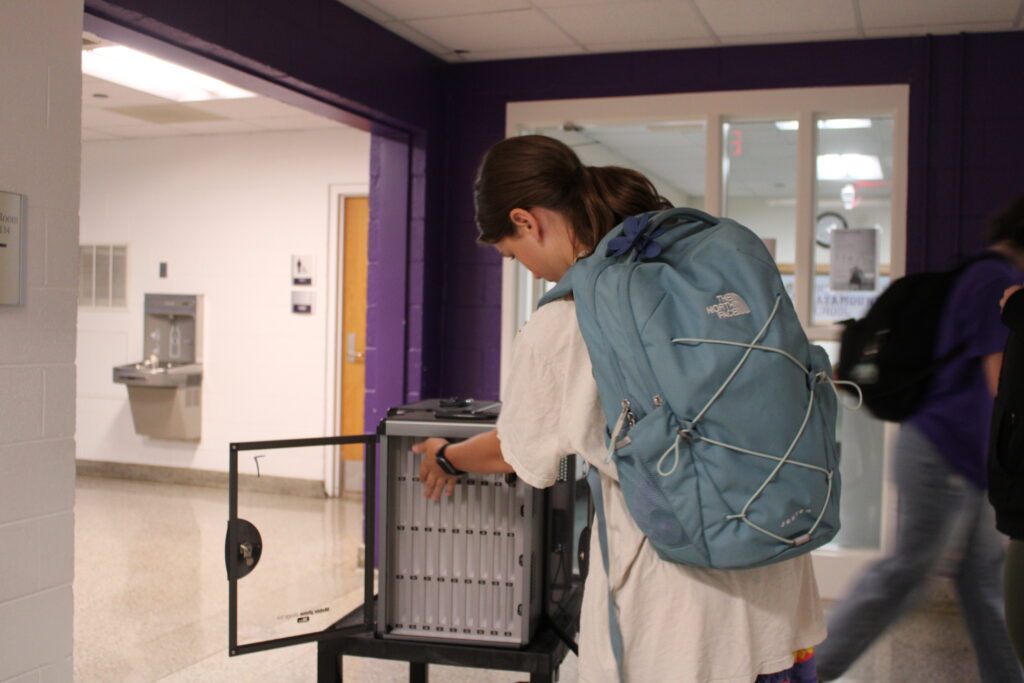
When students arrive at the beginning of the school day, they place their phones in a special box. Each student has a numbered slot, corresponding with their laptop numbers, to make the process simple. After the phones are collected, the boxes are stored in the office until the school day is over.
Principal Sarah Tatham says that students, parents and staff members have all positively responded to the new policy.
“We anticipated gnashing of teeth, but I feel like they feel relieved that they don’t have that piece of their day to navigate,” Tatham said. “Not one single kid has really complained about this process.”
TCS eased families into the policy by making sure everyone was aware of expectations during summer orientation before classes started.
The school decided to go with a blanket “no phones” policy to alleviate the burden on teachers.
“We didn’t want the responsibility on the teachers to have to navigate what is an educational use and what is not an educational use,” Tatham said. “We didn’t want them to have to police it all day long.”