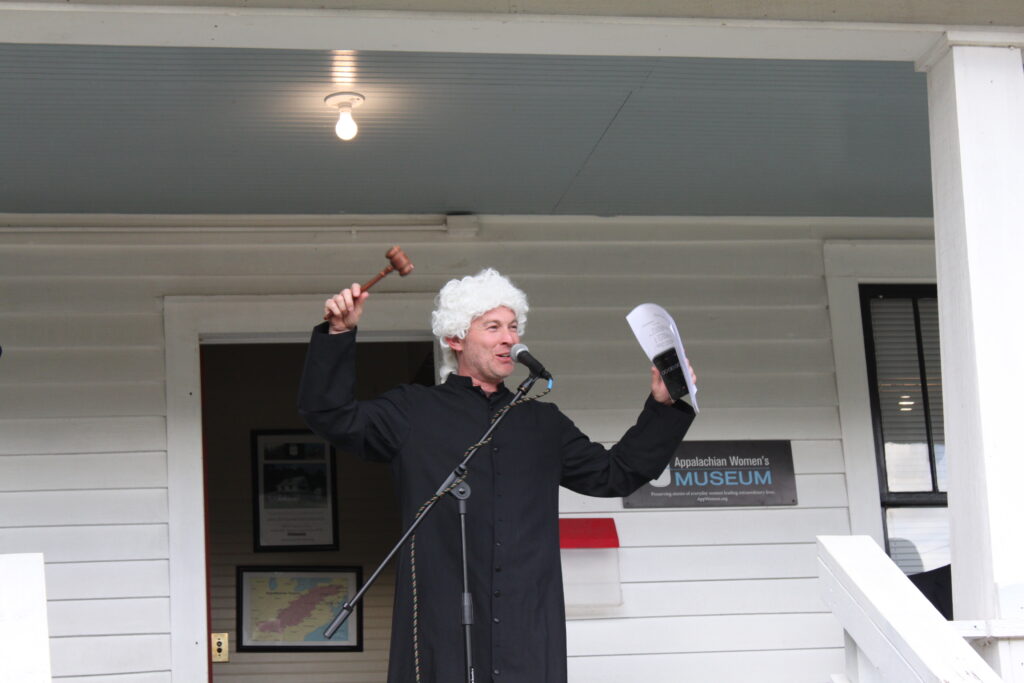
In an outdoor courtroom featuring war itself as the defendant, War was found guilty on all eight symbolic charges.
A mock trial held on Oct. 7 at the Appalachian Women’s Museum in Dillsboro, where Western Carolina University students, faculty and community members gathered to debate the ethics and consequences of armed conflict.
The event was hosted by WCU’s Diane Coyle Peace and Justice Committee in partnership with Warm Cookies of the Revolution, a Denver-based civic health club known for blending serious issues with playful formats.
Evan Weissman, co-founder of Warm Cookies of the Revolution, opened the evening by declaring the audience a jury and introducing the defendants, puppets of the three symbolic representations of war.
“You may not just sit there and zone out,” Weissman said. “You’re part of this.”
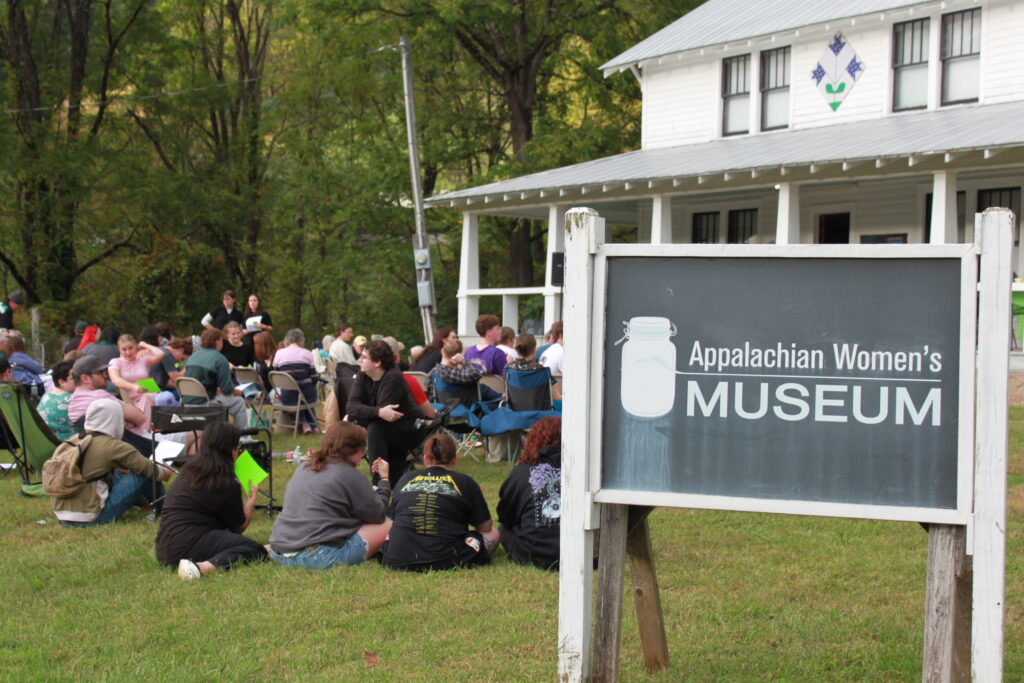
The courtroom-style event featured faculty members and students portraying lawyers, expert witnesses and historical figures like Henry David Thoreau. Dr. David Henderson, associate professor of philosophy and religion, led the prosecution, arguing that war distorts values, destroys lives and undermines democracy.
“War is not just any use of force,” Henderson said. “It is the ravaging of landscapes and peoples, the leveling of cities and the cultivation of generational enmities.”
The defense, led by Dr. Jonathan LaTourelle and Dr. Chuck Fagan, argued that war is a natural part of human history and sometimes necessary to end oppression.
“We are living in the most peaceful time in human history,” LaTourelle said, citing declining global battle deaths and the deterrent effect of nuclear weapons.
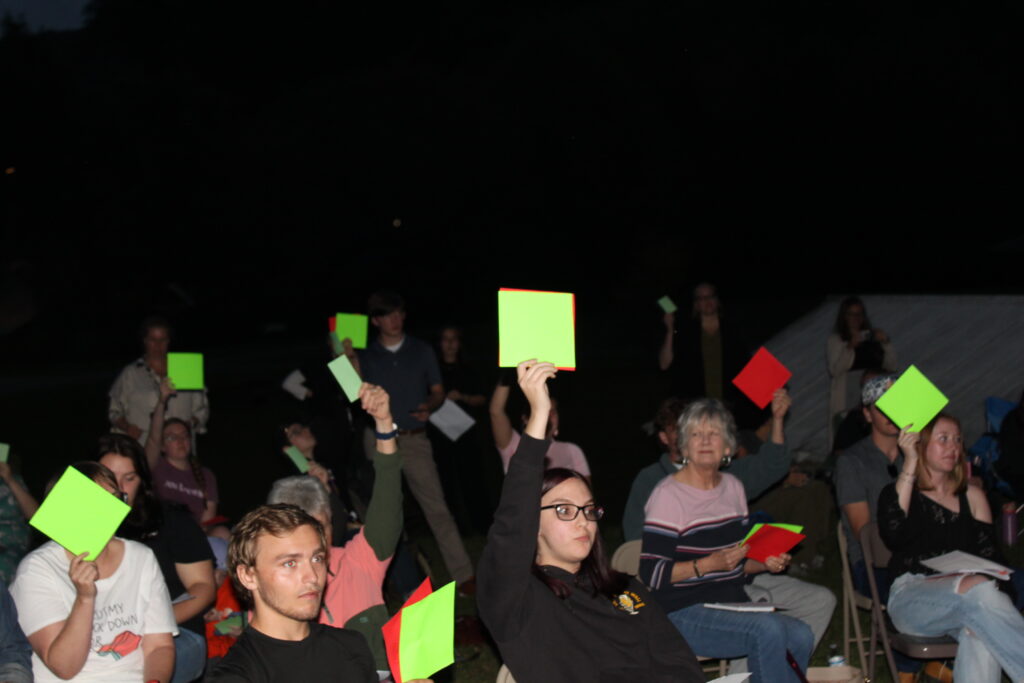
Once both arguments regarding the guilt of war were heard, attendees served as jurors, voting charge by charge with red and green cards to determine war’s guilt, ultimately finding war guilty of mass destruction, theft, disturbing the peace, manipulation of youth, fraud, possession of weapons of mass destruction, emotional abuse of veterans and being a repeat offender.
Adrian H. Molina, co-director of Warm Cookies and performing as “Marvin the Court Reporter,” closed the evening with a poetic scribe drawn from the trial’s dialogue. His piece reflected on war’s paradoxes, human nature and the possibility of peace.
“There is always a new America to build,” Molina said. “We, the humans, victims, perpetrators, prosecution, defense, judge, jury and executioners.”
Students who came to the trial had fun and learned more about war and peace.
“Everyone who spoke was super well-spoken and educated,” Laura Overby, a Junior at WCU who helped organize the event through Dr. Vincent Russell’s class said. “It was a very organized event. I mean, who likes war? But I’ll admit, the defense made some really good points. It was nuanced, and I appreciated that.”
Amelia Wheeler, assistant professor of education and a member of the Coyle Peace and Justice Committee, said the event reflected the kind of civic engagement she’s worked to foster throughout her career.
“Though we were prosecuting war, we were kind of this living embodiment of a more peaceful society,” Wheeler said. “Multiple organizations donated food, sound equipment, time and expertise. It was peace work in action.”
Wheeler also praised the audience’s attentiveness. “People were really engaged. No one was scrolling on their phones. They were in it.”
Vincent Russell, chair of the Diane Coyle Committee, said attendance more than doubled previous Peace and Justice Fund events.
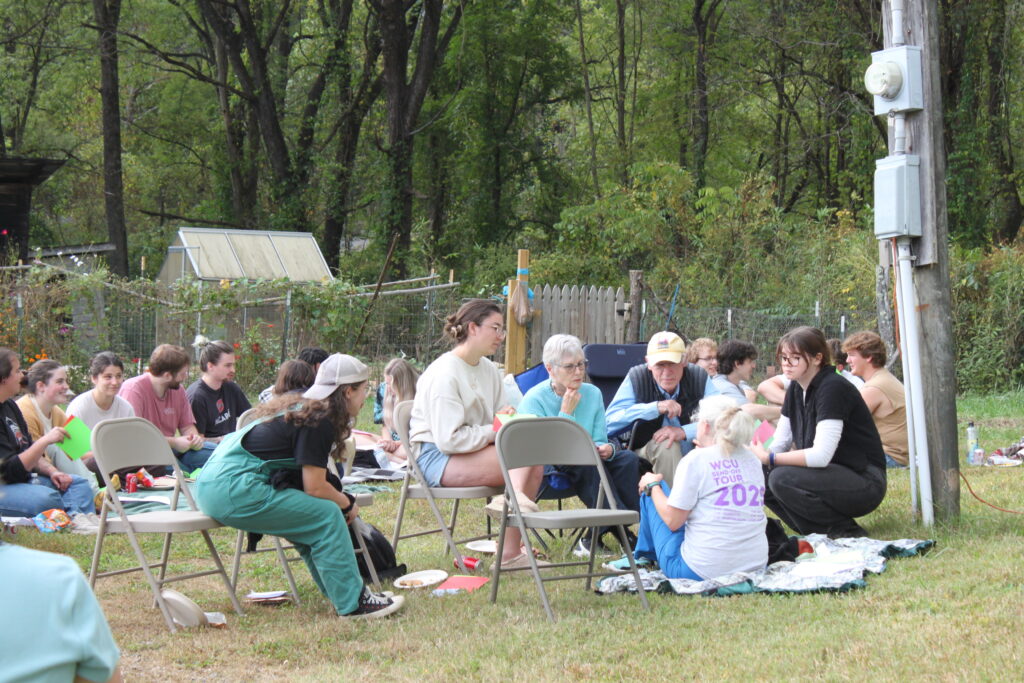
Attendees of the Trial on War discuss trial details in small groups. Photo by Hannah Butler
“I’m over the moon with how this turned out,” Russell said. “The community support was incredible. Our partners helped make this a success and brought people out.”
Russell said the verdict wasn’t a foregone conclusion.
“Anything could happen,” he said. “But the more important thing was the conversation. In my small group, a veteran shared his experiences, and that was powerful for those of us without military backgrounds.”
The Coyle Peace and Justice Committee plans to host a similar event annually. Wheeler said the group will review survey data and begin planning next year’s theme soon.
“We’re interested in doing more community-university hybrid events that are participatory,” Russell said. “This trial showed how powerful that can be.”
The Coyle Peace and Justice Committee is a campus group in honor of Diane Coyle, a WCU graduate and former art instructor who was deeply committed to world peace, dedicated to fostering civic dialogue and creative engagement around issues of peace, justice and democracy. The committee was established through the Coyle Peace and Justice Fund, created by Dr. Fred Coyle in honor of his late wife. Each year, the fund supports public programming that encourages critical thinking and community participation.