On the nights of Nov. 11 and 12, the Aurora Borealis could be seen in hues of pink and green above areas of low-light pollution in and around the WCU area. This granted the residents of Cullowhee brave enough to face the cold with the perfect opportunity to cross viewing the lights off of their bucket lists.
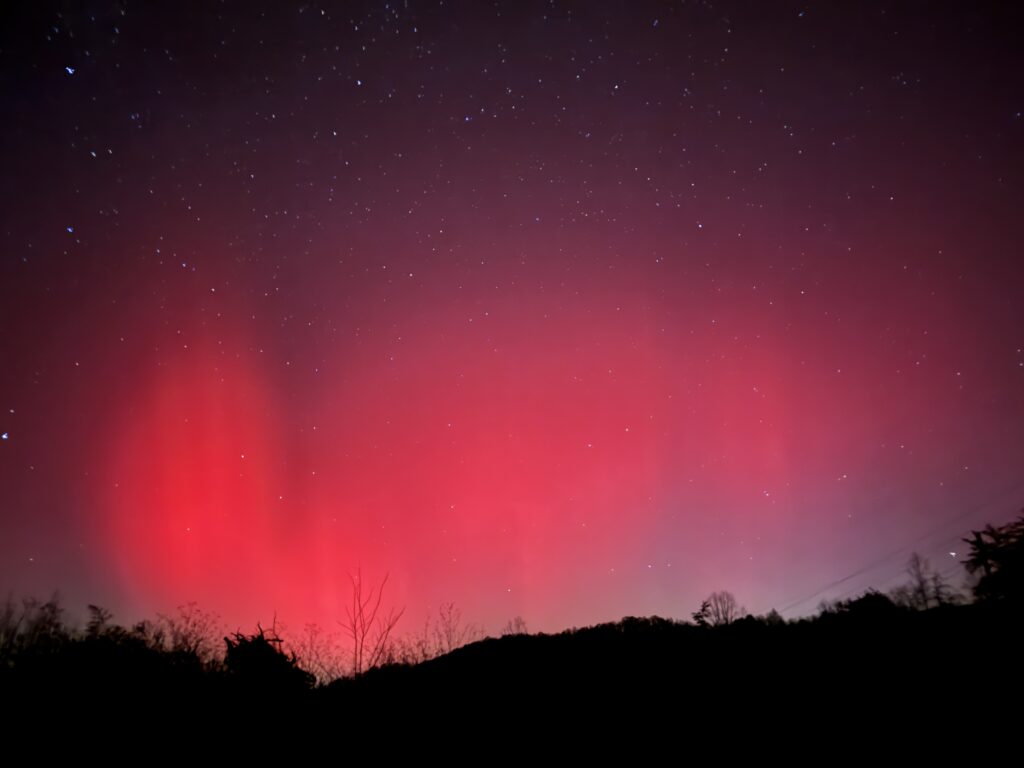
Due to a disturbance of Earth’s magnetic field called a geomagnetic storm, Kp index levels went from 4 all the way up to 9, peaking late on Nov. 11 and early Nov. 12 according to the NOAA’s (National Oceanic and Atmospheric Administration) Space Weather Prediction Center.
The Kp index is a scale used to measure the strength of geomagnetic activity, ranging from 0 to 9. The higher the number, the more intense the disturbance in Earth’s magnetic field, and the more likely it is that auroras will be visible farther from the poles. These disturbances are often caused by coronal mass ejections (CME’s) which are massive bursts of solar plasma and magnetic energy released from the sun. A Kp of 4 signals active conditions, while anything above 7 is considered a strong geomagnetic storm. With levels peaking at 9 during the event, this unusually high activity allowed the aurora to dip far below their typical range, allowing it to be visible across much of the United States, including Western North Carolina.
According to Dr. Enrique Gómez, professor of physics and astronomy at Western Carolina University, this particular storm was driven by not one, but three CMEs that erupted from a sunspot on the sun’s surface.
“One overtook the other, which really built up the energy,” Gómez explained. “That’s why we saw auroras as far south as Florida and even Mexico.”
Known as the Northern Lights or Aurora Borealis, these colorful lights usually appear in high-latitude regions like Alaska, Canada and parts of Scandinavia. Their presence over Cullowhee was made possible, due to the strength of the geomagnetic storm which sent charged particles from the sun crashing into Earth’s magnetic field. When those particles collide with gases in the upper atmosphere, they produce waves of color that ripple across the sky in what we see as the Northern Lights.
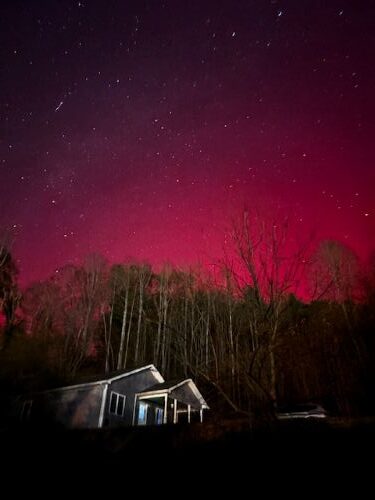
The Northern Lights over Cullowhee glowed mostly pinkish red with hints of green, and that color mix wasn’t random. It comes down to how solar particles interact with Earth’s atmosphere. High above campus, those particles collided with hydrogen, nitrogen, and high-altitude oxygen, producing the vibrant pinks that lit up the sky.
“What we saw with the pink is hydrogen alpha emission from water,” Gómez said, referring to the hydrogen released when energetic particles break down water molecules in the upper atmosphere.
The green, more familiar in aurora displays, came from oxygen lower in the atmosphere and appeared closer to the horizon.
While auroras in places like Alaska often show deeper reds, purples or even blues, the lights in Western North Carolina were shaped by our southern vantage point and the strength of the storm.
Gómez noted that the sun is currently in an especially active phase.
“We are coming into a maximum of the sun in the next few months,” he said. “It’s been a particularly active phase of the solar cycle.”
Solar activity has surged in recent months as the sun nears the peak of its 11-year cycle, known as Solar Cycle 25. This increase has led to more frequent solar flares and coronal mass ejections (CMEs), which can trigger geomagnetic storms and expand auroral visibility. According to NOAA’s Space Weather Prediction Center, the sun produced several CMEs in early November, including the ones responsible for the G4-level storm that lit up skies across the U.S.
As Solar Maximum approaches in late 2025, experts expect more events like this, making southern aurora sightings increasingly possible. With more solar storms likely on the horizon, Gómez recommends checking sites like spaceweather.gov to track aurora forecasts and Kp index updates.
“We really won’t know until 24 hours out,” he said, “but there’s definitely a good chance we’ll see more.”