On a campus known for civic engagement, one speaker encouraged students to rethink the very law that made voting more accessible.
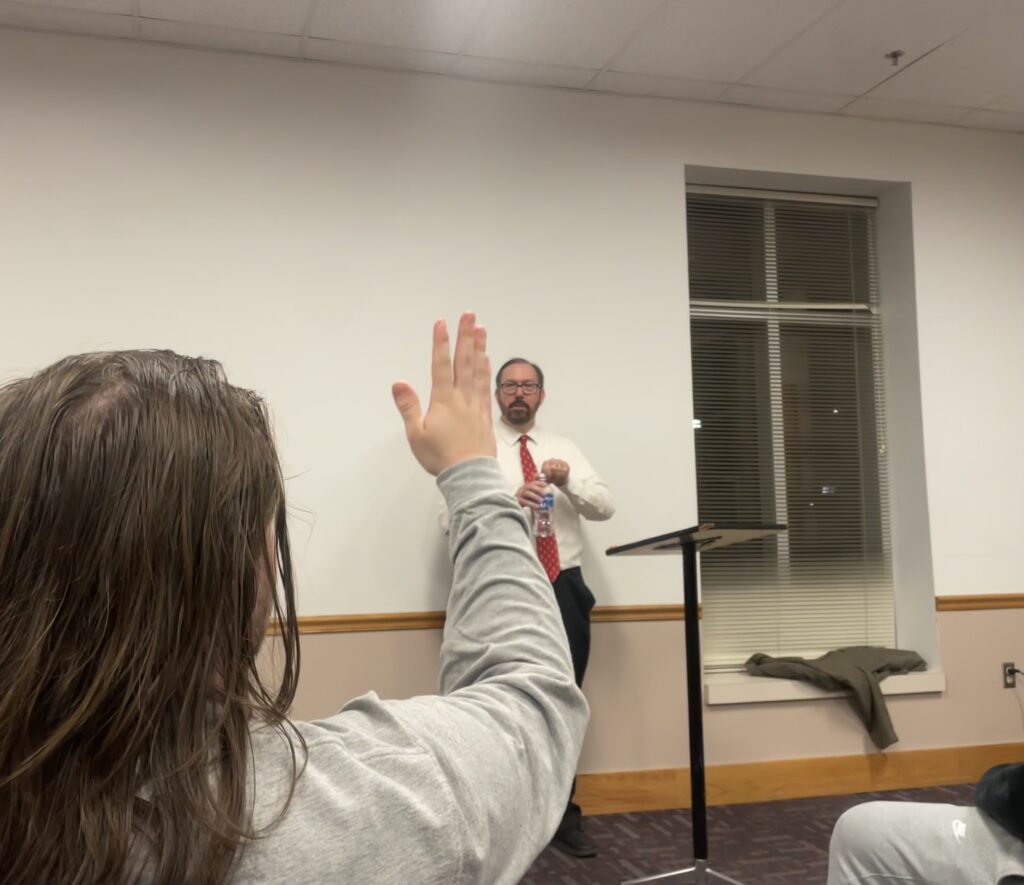
At a speaker series honoring the 60th anniversary of the Voting Rights Act, Dr. Andy Jackson director of the Civitas Center for Public Integrity at the John Locke Foundation, argued that federal oversight of elections has gone too far, and that the law’s most powerful enforcement tool is no longer justified.
Jackson’s talk, part of the “Who Decides Who Decides?” speaker series hosted by the Phil and Connie Haire Institute for Public Policy, attracted a large enough crowd of students and community members that the event reached capacity.
Jackson speech focused on the 2013 Supreme Court decision in Shelby County v. Holder, which struck down the formula used to determine which jurisdictions required federal preclearance before changing voting laws.
The event took place two weeks after the first series of “Who Decides Who Decides?” where voting policy scholar from the Brennan Center for Justice, Kevin Morris defended the Voting Rights Act as a vital safeguard against racial discrimination.
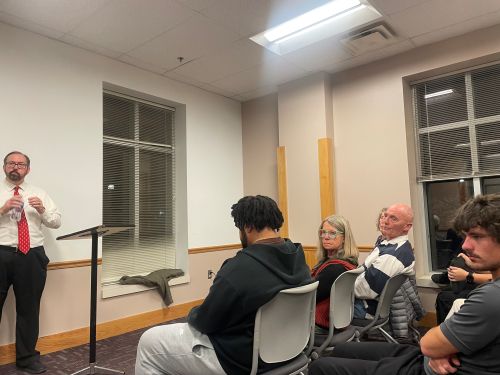
“Preclearance was an extraordinary measure,” Jackson said. “The Court ruled that the justification no longer exists because the formula was outdated.”
Jackson emphasized that the Voting Rights Act does not guarantee racial proportionality in elected offices and does not require the election of candidates from any particular party. He argued that both Democrats and Republicans have used redistricting to manipulate Black voting power either by concentrating voters into fewer districts or spreading them thin across many.
“Electing Democrats isn’t enough,” he said. “Sprinkling voters across districts can be just as harmful as packing them.”
Jackson cited a Michigan case where a redistricting commission reduced the number of Black-majority districts in Detroit. Though the commission claimed it would increase voter influence, courts ruled the change diluted Black voting power. Jackson also referenced a rare case in Mississippi where a Black election official was found to have suppressed white voters, underscoring that the Voting Rights Act protects all races.
While Morris pointed to a wave of restrictive voting laws following Shelby, Jackson said the data is mixed. Some studies show a decline in Black turnout, while others show no significant change. He noted that voter ID laws may have even mobilized turnout through backlash.
“Human beings are complicated,” Jackson said. “Different methods produce different results.”
He closed by criticizing Congress for failing to update the preclearance formula, which the Supreme Court said was necessary to justify continued federal oversight.
“Congress has not done its job,” he said. “If you want preclearance back, you need a new formula.”