WCU Student Democracy Coalition is calling students to sign petition to keep the voting place at the WCU University Center open. The new Jackson County Board of Elections will discuss the consolidation of voting places in Cullowhee precinct next week.
The Jackson County Board of Elections will hold a meeting on Dec. 9 at 10 a.m. at the Commissioners’ Chambers on the 2nd floor of the Jackson County Justice and Administration Center. The meeting was moved in anticipation a larger crowd showing up to the meeting.
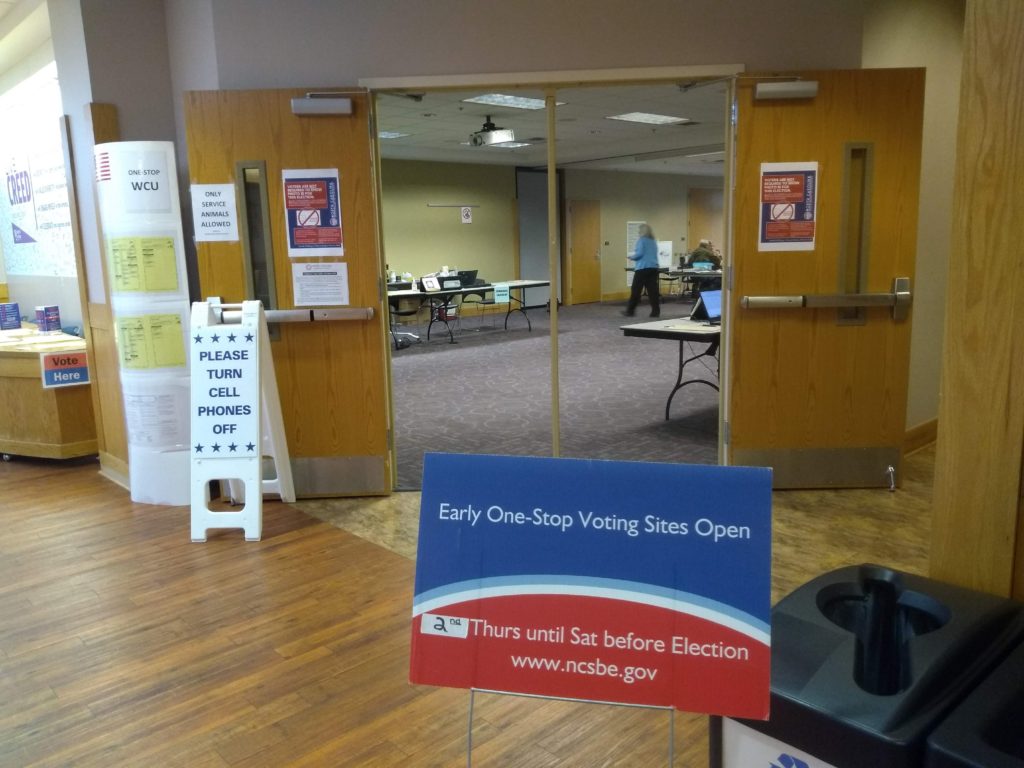
In an email to Western Carolina Journalist, the director of Jackson County Board of Elections Amanda Allen clarified that the Board are considering consolidation of the Cullowhee Recreation Center and WCU early voting sites into one that can serve the whole area. That does not necessarily mean that WCU’s site will close.
In an interview with WLOS, Jay Pavey, a member of the board, told them that the consolidation is because of how expensive it is to keep open multiple polling places.
Polling sites cost in between $17,000 and $20,000 to operate it.
“By closing one site, there will be savings of at least $15,000,” Pavey told WLOS.
According to the data from the board, there are currently over 5000 registered active voters and 1,454 inactive voters or 6,558 total registered in the Cullowhee precinct. It is the largest precinct in the county. Based on residential address, there are 1,267 active and 388 inactive individuals registered with on-campus WCU addresses.
Former director of the Center for Community Engagement and Service Learning and current assistant professor at the College of Business, Dr. Lane Perry worked with the SDC and WCU leaders to open the polling place on campus in 2016. In an email, he said that polling place has been a great resource for helping support the community and develop youth civic engagement habits through voting.
“The campus early-voting site has historically supported student engagement by offering a visible, convenient location that helped draw in new voters, while also engaging local voters too. Because turnout often decreases when polling places change, removing the WCU site could lower overall participation and add pressure to other voting locations,” Perry said.
He added that over the years, thousands of students have registered and voted (many for their first time) – seamlessly – due to the accessibility of the on-campus polling place; voting side-by-side with community members and constituents representing all parties.
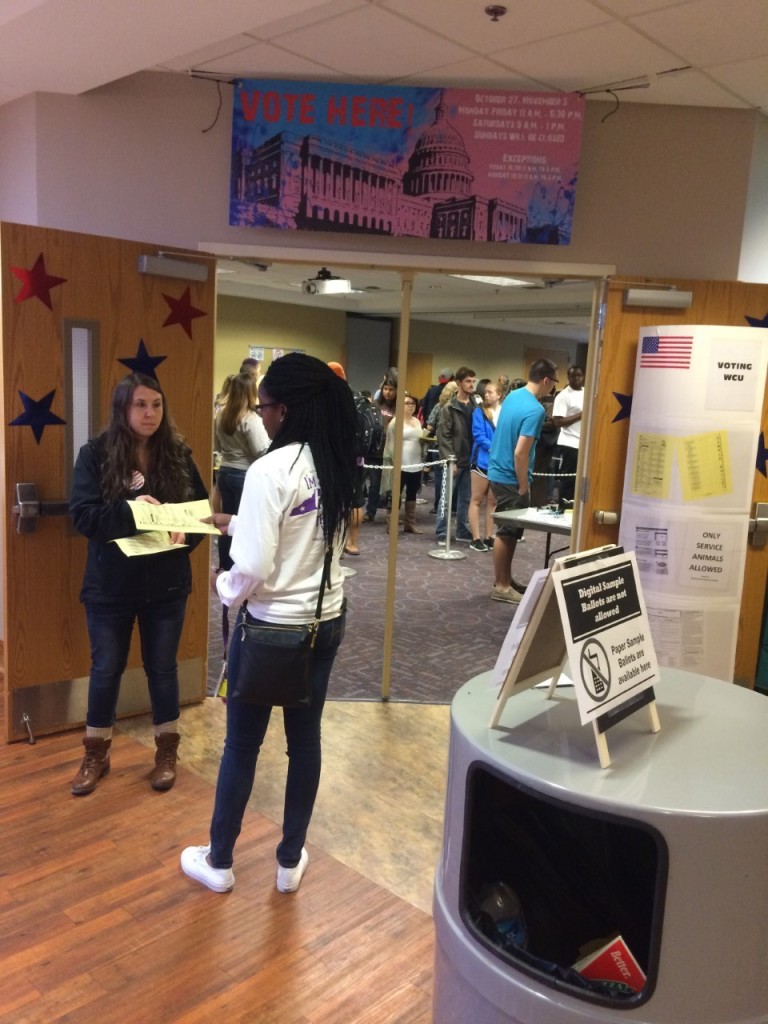
College Democrats and College Republicans are supporting Student Democracy Coalition initiative.
“Our polling place makes it so that students, faculty, and staff don’t have to go off campus on maybe an extremely busy day,” said Evie Corn, a junior at WCU and the vice president of the Student Democracy Coalition.
Corn and the SDC are working closely with the CCESL to promote voting with students and get students to sign a petition to stop the closing of the voting site on campus.
“Our goal is to just be able to try and get students to register to vote and be educated about voting,” Corn said.
Corn thinks that voting is a very important right that American citizens have.
“It is a fundamental right here, there are other countries where voting is not as accessible,” Corn said. “I feel like a lot of people take it for granted.”
Corn believes that it is important for students to be able to have a voting site on campus.
“The importance of the polling place on campus is the accessibility of it,” Corn said. “To have a polling place in certain areas, you have to be thinking about people that are in that area.”
The meeting where the change was brought up took place on Nov. 17, where the Board of Elections brought up the change. Corn went to the meeting, and had some complaints about how things were handled at the meeting.
“There was some, I would say, unprofessionalism, demonstrated at the initial meeting that the board held,” Corn said. “The person who started the meeting announced as they started that it was his goal to close WCU’s polling place.”
A big argument at the meeting was how the UC was partisan. Corn has other thoughts about the UC.
“That’s a claim I don’t really understand, because that would be illegal,” Corn said. “Legally, the UC is required to stay nonpartisan. Some RSOs are partisan, but however, during polling season, when a polling place is on campus, RSOs are not allowed to run in the UC.”
Corn and others are getting people across WCU to sign a petition on keeping the polling place open.
“We have around 200 signatures now, and we definitely want to get that number up,” Corn said. “But in our petition, it has been an overwhelming amount of support.”
The petition has multiple questions regarding voting at WCU.

“We have questions within the petition such as ‘are you a Jackson County resident’ and it’s been an overwhelming majority of people being like ‘yes, I’m reliant on this,” Corn said.
Corn also wants people to take this as a teaching moment.
“I think this is a really horrible but great example oh how voting can be a privilege and that there will be people that will come along that will try and take that privilege away,” Corn said.
WCU polling place was opened in 2016 and increased student turnout in the 2016 elections
National Study of Learning, Voting, and Engagement (NSLVE) at Tufts University’s Institute for Democracy and Higher Education shows that more than half of college students voted in the 2024 presidential election. According to the NSLVE data, 76% of college students were registered to vote and 53% of all eligible students voted. Western Carolina University was recognized as one of the Most Engaged Campuses for College Student Voting in 2024 by @allintovote!
For more information, head to jcncelections.org.