Almost 80 people attended the Martin Luther King Jr. march on Monday, Jan. 19 brandishing anti-racist protest signs as the crowd started from the UC Plaza, past the library, circling past the Apodaca science building, and finally ending at the UC Plaza.
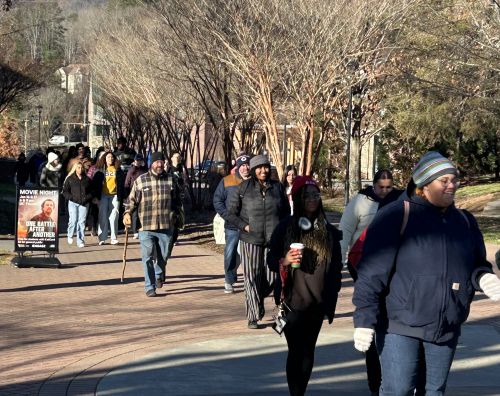
The WCU chapter of Alpha Phi Alpha organized the march in collaboration with the Black Student Union, the Center for Community Engagement and Service Learning, the Global Black Studies Program, and the Global Black Studies Club. WCU’s chancellor, Kelli R. Brown, delivered an opening statement before the march.
“It’s a much bigger turnout than last year,” Brown said. “I’ve done many of these in the past, but never with a turnout like this one in this awful cold.”
It was 21 degrees when the march started.
Alpha Phi Alpha was responsible for the bulk of the planning and organization of both the march and the seminar after the march. The fraternity worked closely with the Director of Global Black Studies, Frederick Dixon, to make both events possible.
“We also want our students to come out to understand that a part of this is social responsibility. It’s more than social media; it’s a physical gathering for social equality and change,” Dixon said.
Alpha Phi Alpha is the oldest Black fraternity in the United States. The fraternity was founded by the “Jewels” on Dec. 4, 1906, in Ithaca, New York. Members of the fraternity include civil rights leaders Thurgood Marshall and Martin Luther King Jr.
“The work we do here is based on King’s work in racial justice and social equality,” said Alpha Phi Alpha member and WCU student AJ Andrews.
“DEI programs being eliminated in the federal government makes this march more relevant than ever,” said John Walker, another Alpha Phi Alpha member.
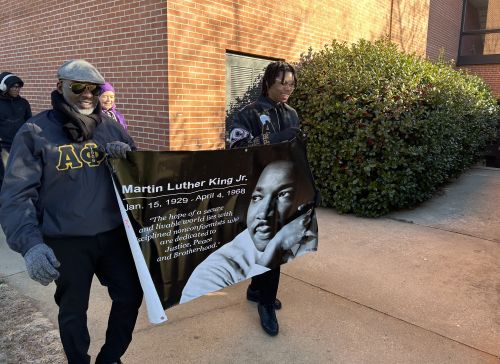
During the seminar after the march, Dixon gave a lecture where he compared the work, legacy and similarities of Martin Luther King Jr. and Malcolm X, arguing that King’s legacy was assassinated before King was.
“Dr. King was arguably more radical than Malcolm X. King was arrested over 30 times while Malcolm X was only arrested and incarcerated once. People also thought King was more radical in the measures he was taking with the Montgomery Bus Boycott,” Dixon said.
Dixon used data to show how public opinion on King and his work switched from negative to positive during the years after the assassination turning him from a radical into a diplomat in history.
“We’re attempting to respond to his character assassination. How do we do that? We read his work, we do a contextual analysis,” Dixon said, explaining why he believes the march remains relevant today. “That is the best approach to understanding Dr. King in a manner that more represents him.”
The seminar also included a panel of student activists and organization leaders. Panelists included Black Global Studies Club members Jasmine Burgess, Vernon Collins, and Michaela Nelson.
“Martin Luther King Jr. Day isn’t just a day off work, it’s a chance for protest and social gathering to make change,” said Collins.
The Associate Vice Chancellor for Student Success, William Moultrie, moderated the panel. Speakers answered questions from both Moultrie and the audience.
Guests enjoyed free chicken, biscuits, mashed potatoes and mac n’ cheese courtesy of Bojangles.