Students will no longer be able to vote at Western Carolina University’s polling place, following the decision made by the State Board of Elections on Jan. 13.
Jackson County Board of Elections in December split on the decision to consolidate Jackson County’s polling locations and closing of the early voting site at WCU University Center in a 3-2 vote.
Jackson County was amongst a dozen election board counties that did not reach a unanimous agreement. The other colleges included in the Republicans’ State Board of Elections decision to close their polling places include North Carolina Agricultural and Technical State University, Elon University, and the University of North Carolina at Greensboro.
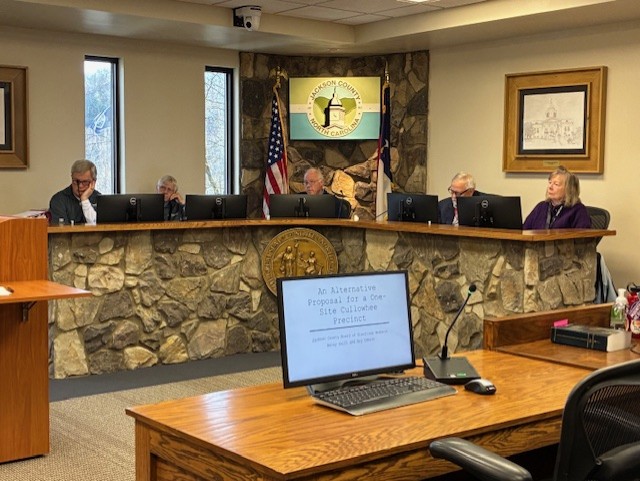
The Jackson County Board of Elections presented the State Board of Elections with two proposals: a majority plan represented by republican members, which consolidated early voting sites in Cullowhee to a single location, and a minority plan represented by the democratic members that pushed to preserve WCU’s polling site or consolidate the early voting site to WCU’s Health and Human Services Building.
The majority’s plan for changing the early voting location in Jackson County is that there is no reason to have two sites in Cullowhee, stating that the sites are two miles apart and each site costs the county $20,000 per election, making this year’s second primary an additional $45,000 to $60,000, according to the Republican majority plan presented to the state. The majority also presented that in the past, WCU’s voting site was not easily accessible to the general public, as the JCBOE chair Bill Thompson argued, justifying the decision to close the site in December.
The minority plan states that WCU’s voting place has historically been a location where college students vote, and it gives access to underrepresented voter demographics.
Amanda Allen, director of the Jackson County Board of Elections, explains the cost per polling place, clarifying that the money spent towards each polling place is for paying the poll workers.
“That $20,000 figure is a rough estimate per site, and for most locations, the majority of that cost is staffing,” Allen said. “We already own the voting equipment… we don’t pay rent at the WCU facility.”
Allen adds that early voting plans have always been revisited before every election.
“Not having the campus site this time does not mean that we might not go back to Western in the future,” Allen said. “It does not mean that we might stay consolidated, but at a different location.”
Having the polling place on campus has increased early voting among the ages 18 to 25 in Jackson County since it opened in 2016, more than statewide participation from 4.3% to 9.6%, and it had the highest proportion of same-day registration in the state. The minority plan argued that maintaining a polling place on WCU’s campus has increased voter activity without diminishing voter accessibility for all demographics.
The two sites that were reviewed were the Cullowhee Recreation Center and the Health and Human Sciences building at WCU, with the final decision made by the State Board of Elections to have the polling place at the Cullowhee Recreation Center due to its well-known location, parking availability, locations for campaigning, and easy accessibility.
Jay Pavey, a Republican member of the Jackson County Board of Elections, said the early voting site moving to the Cullowhee Recreation Center was a move based on cost, amongst other factors, noting that only about 4.5% of voters use the campus polling site during the last primary.
“If you look at the student population and the number of people who had voted, they only had about 525 or 540 people who voted. Conversely, there was over 700 people who used the Cullowhee Recreational Center,” Pavey said.
Pavey says that by closing the WCU polling site that accommodates roughly 1,300 voters it would save the county $40,000.
Addressing the concerns about whether moving the voting site would lower voter turnout, Pavey said, “We’ve had people accuse us of that we’re trying to suppress the vote, which is not true… I’ve always been very, very pro-vote, and I want everyone to vote, but I also think we’ve got to balance cost.”
Pavey also noted that this change is not absolute. “This is just the primary. This is not what it may look like for the midterms and certainly not the general.”
WCU reactions
Savannah McGlothlin, president of the Student Democracy Coalition resigned at the beginning of the 2026 academic year. Her decision to step down from her role was partly influenced by the closure of WCU’s polling place creating barriers with civic engagement for students.
“Both the Vice President and I resigned at the beginning of this semester,” McGlothlin said. “Part of that is just because we have faced so many roadblocks and challenges to trying to provide the community with a way to be civically engaged, trying to provide people with as many resources as possible.”
McGlothlin voiced student sentiment that the closure of the campus polling place hit voter morale.
“Not being able to get there physically and just feeling like our voices don’t matter and there’s no point in voting anyways because our voices don’t matter. I feel like it’s going to affect voter turnout in this area,” McGlothlin said.
Zach Powell, president of the College Democrats at WCU, also advocates for keeping the on-campus voting site open and expressed concern for a potential decrease in voter turnout because of the change in location.
“Any time a polling site is eliminated or moved, it creates confusion for the voters that were served by that site,” Powell said in an email.
The Republican members on the State Board of Elections stressed the main concern for moving the polling location was to save money. However, Powell suggests that closing the polling place on campus had some financial redundancies.
“The facility will have to accommodate the increase in voters, and there will need to be enough poll workers to process same-day registrations,” Powell said.
Powell added, “Over 70% of same-day registrations came from the university polling site in 2024. Those take time and labor to process. These accommodations will offset a lot of the projected savings.”
Powell also notes that most of the population of Cullowhee is made up of residents living near or on WCU’s campus, adding “64% of students living on campus do not have a car, and the Cullowhee Recreation Center is not included in Cat-Tran routes.”
To combat the lack of accessible transportation for students the College Democrats of WCU is organizing a “March to the Polls” event.
“The idea is to organize a group of students together who are willing to complete the 3.4-mile round trip on foot, so that we can document our experience and demonstrate how dangerous and difficult the walk is for students with no transportation,” Powell said.
Political science professor and N.C. election and political expert Dr. Chris Cooper used data to show that closing WCU site will impact the young vote. His analysis shows that the WCU voting site increased youth vote, putting the county in second place in the state by registered voters under 26 years old.
As Jackson County prepares for the 2026 primary, Amanda Allen says voters should know several key deadlines:
- Voter registration and deadline to change party ends Feb. 6. at 5 p.m.
- Absentee ballot requests are available now online, and requests must be submitted by Feb. 17.
- Early voting period is Feb. 12 through Feb. 28. The early voting period is the only time after the voter registration deadline to register to vote.