Story written by Cory Vaillancourt, re-published from The Smoky Mountain News
Amid growing financial concerns, Jackson County’s four Republican commissioners have spent the last few years fighting a culture war. On March 3, Primary Election voters will weigh in on their priorities.
Over the past four budget cycles, Jackson County commissioners have overseen a steady expansion of county government, with the general fund growing from $71.7 million in fiscal year 2021-22 to $106.9 million in 2025-26, an increase of roughly 49% over five years.
Each budget was adopted with growth driven largely by rising personnel costs, expanded public safety staffing, capital maintenance demands and inflation-adjusted operating expenses rather than major new service lines.
Much of that growth has been incremental, rather than abrupt. The general fund increased to $88.1 million in 2023-24 and $93.8 million in 2024-25 before crossing the $100 million threshold in 2025-26, with annual increases ranging from about 4% to 6%. Throughout that period, commissioners repeatedly funded across-the-board step increases and cost-of-living adjustments for county employees, committing more than $1 million per year to compensation alone in recent budgets to retain staff amid regional labor shortages.
Capital planning has also remained a consistent pressure point. Approved budgets show recurring capital and capital improvement needs ranging from about $4.1 million to $5.8 million annually, covering vehicles, equipment and deferred maintenance at county facilities, jails, recreation complexes and libraries.
Commissioners have generally relied on pay-as-you-go funding, capital reserve transfers and targeted fund balance expenditures to address those needs, keeping non-education debt as a relatively small share of overall expenditures.
Taken together, the budgets reflect a county that has grown more expensive to operate but has so far avoided sharp fiscal shocks — until last year.
During the county’s previous property revaluation, which took effect for the 2021-22 fiscal year, commissioners opted not to go with a revenue-neutral rate amid rising property valuations; the revenue-neutral rate was 34.47 cents per $100 in assessed value, but commissioners settled on a 36-cent rate. For the next three years, that rate increased to and remained at 38 cents. For the latest revaluation, which was reflected in the current budget, the revenue-neutral rate was 26.89 cents per $100; however, commissioners went with 31 cents.
Although the current rate is far lower than the previous 38 cents, the 31-cent rate actually represents a whopping tax increase, as property values have skyrocketed since the last revaluation. Before the 2025 revaluation, the total value of taxable property in Jackson County was roughly $11.45 billion. After the revaluation, the total value increased by almost $7 billion, or about 60%.
Canopy MLS said last December that the median sales price of homes in Jackson County jumped 7% year-over year to $395,000, with the average sales price climbing 64.6% to more than $745,000 — among the highest in the region.
Further expansion of county government seems imminent, as commissioners voted 4-1 to leave the decades-old Fontana Regional Library system over LGBTQ content. That means that as of July 1, county government will, for the first time ever, be getting into the library business by operating Jackson County’s two existing libraries.
The vote to withdraw from the FRL was fueled by falsehoods, slander and spin by agitators from outside Jackson County and was made over the overwhelming opposition of people who spoke at multiple public comment sessions against withdrawal. The Smoky Mountain News and the Sylva Herald were recently threatened by an anonymous email from supporters of the withdrawal for reporting on the issue.
Initially, the county projected a $500,000 increase in operational costs attributable to the library. On Jan. 20, commissioners voted 4-1 to put the rubber on the road, transferring $350,000 from fund balance to pay for some of the equipment that will be needed to operate the library.
Commission Chair Mark Letson was the only commissioner to vote against the library withdrawal and was the only commissioner to vote against spending the $350,000.
The real cost of separation won’t become fully apparent until the formal separation takes place this summer — or until commissioners start working on the 2026-27 budget later this winter — however, Letson recently told SMN that he expects the true cost could be triple the initial $500,000 estimate.
But the library issue isn’t the first issue where most commissioners failed to heed the will of the people.
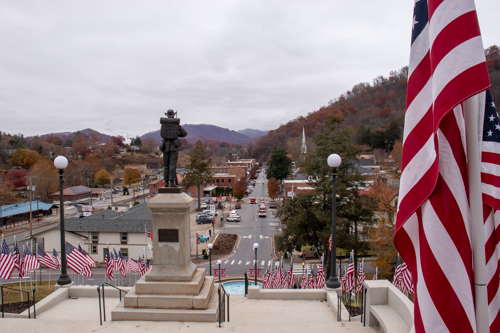
Jackson County’s handling of its Confederate monument sparked intense debate and questions about transparency in government when, in April 2025, county employees removed plaques that had been added as a compromise in 2021 to cover the Confederate flag and the words “Our Heroes of the Confederacy” on the statue known locally as “Sylva Sam” — without a vote or public discussion by the commissioners.
An attorney for the North Carolina Press Association told The Smoky Mountain News that commissioners had “without question” violated the public policy of the state of North Carolina. Andy Jackson, director of the conservative Civitas Center for Public Integrity — a brand within the broader John Locke Foundation — said the move “likely violated North Carolina’s open meetings law.”
Beyond budgets, commissioners have also been forced to confront how cultural and governance controversies intersect with Jackson County’s economy and civic reputation.
Tourism remains one of the county’s most significant economic drivers. According to business owners and tourism stakeholders, fights over LGBTQ inclusion and the handling of the Confederate monument risk undermining Jackson County’s appeal to visitors, second-home owners and potential employers by producing measurable downstream effects on lodging, hospitality employment and long-term investment in the county.
Governance itself has also emerged as an issue. Chronic meeting absences by commissioners Jenny Hooper and John Smith over the past two years — plus Smith’s violation of state law by skipping state-mandated ethics training — prompted questions about accountability and whether candidates view attendance as a baseline responsibility of the job.
Education, infrastructure and quality-of-life issues also surfaced during the interview process, though less prominently than fiscal and cultural disputes.
Some candidates raised concerns about school funding priorities and the county’s working relationship with the Jackson County school board, while others pointed to the importance of maintaining constructive relations with the Eastern Band of Cherokee Indians given the tribe’s economic and cultural ties to the county.
Broadband access in rural areas, persistent shortages of affordable housing and childcare and ongoing development pressures affecting the Tuckasegee River were likewise cited by some candidates as issues that merit greater attention from county government — even if they have not dominated recent board debates.
Related story: Western North Carolina braces for 2026 races