A version of this story was published in the Sylva Herald
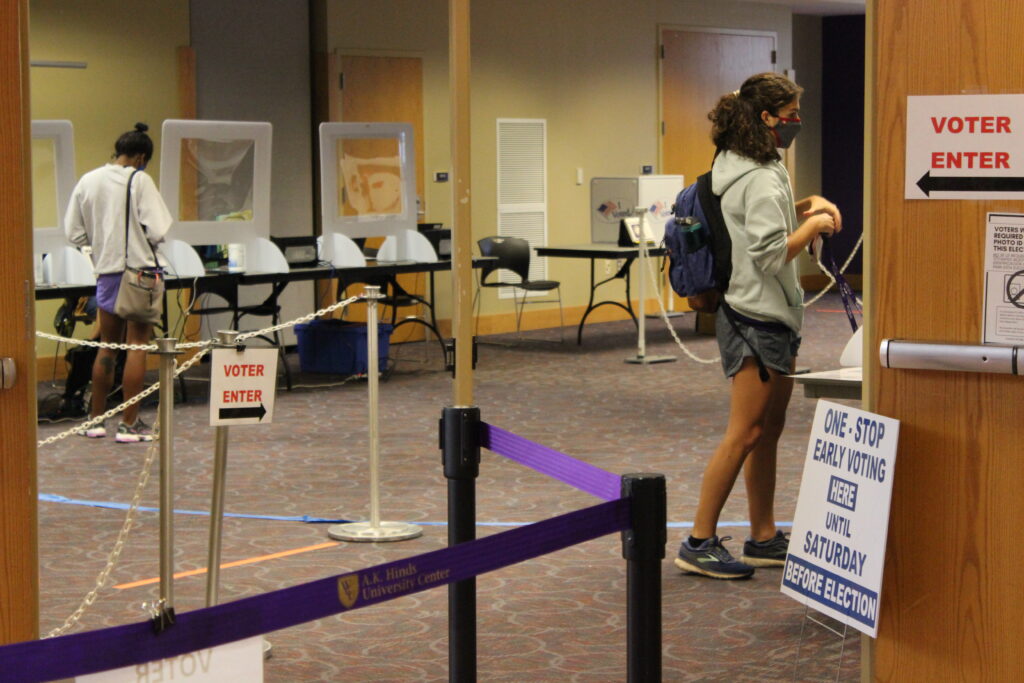
Students at Western Carolina University, North Carolina A&T State University and University of North Carolina at Greensboro will not have early voting sites on their campuses during this year’s primary election, despite efforts by students at these three schools.
In late January, students from the three universities filed a lawsuit against their respective county board of elections and the NC State Board of Elections over the elimination of voting sites at their campuses. On Feb. 8, U.S. District Judge William Osteen Jr. denied their request to restore the site ahead of early voting.
However, according to WCU political science professor Chris Cooper, the board of elections will decide where the voting sites will be located again during the summer.
“So, no matter how this goes, whether it goes for the plaintiffs or the defendants, I think we’re going to rinse and repeat the story this summer,” Cooper said.
The students’ lawsuit stated the removal of the polling sites violated their constitutional rights, citing the 1st, 15th and 26th Amendments specifically. The case references the 26th Amendment heavily which establishes the voting age and states that for citizens 18 or older, the right to vote cannot be denied based on age. The case also references the 15th Amendment, which states the rights of citizens to vote cannot be denied based on “race, color, or previous condition of servitude”.
“State and county officials brushed aside urgent warnings that their decisions would disproportionately burden young and Black voters and denigrated students who advocated for their rights,” the lawsuit states.
For students at WCU, the on-campus early voting site served the second youngest average pool of voters of any site in the state and more Black voters than every other site in Jackson County, according to the lawsuit. With the early voting site, students were also able to take advantage of same-day registration, which the lawsuit states are critical for young voters on college campuses who tend to be new voters or registering at a new address.
“(The removal of the site) creates obstacles and confusion for students who previously used the site,” said plaintiff and president of the WCU division of the NC College Democrats, Zach Powell. “We believe it is an intentional effort to make it more difficult for young people to vote.”
With the removal of the WCU early voting site, the nearest voting location is at the Cullowhee Recreation Center about 2 miles away from WCU’s campus.
“Approximately 64% of WCU students do not have a car which, combined with the lack of public transportation, makes off-campus travel prohibitive for most students,” the lawsuit states.
Since the Jackson County and Guilford County votes to approve the plans were not unanimous, the NC State Board of Elections had the final say on what plan each county would use.
According to the lawsuit, in a move ignoring precedent the board refused to accept public comments on the voting plans. Students from the affected universities still wrote letters describing why they felt they needed the voting sites on campus, and students from NC A&T travelled to Raleigh, NC to express their displeasure with the proposal at the state board’s meeting.
According to the lawsuit the letters were left untouched, and after the meeting State Board member and defendant Francis De Luca threatened to call the police on the students if they did not leave.
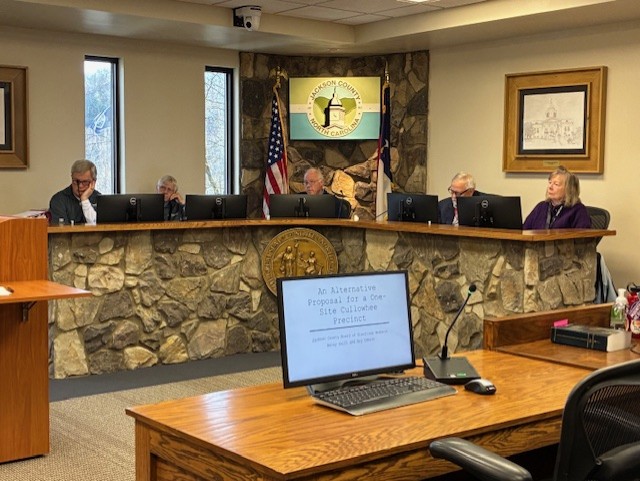
Jackson County Board of Elections Chair Bill Thompson argued before the state board that the students at these universities are adults and should be able to figure it out, dismissing their concerns.
“I would remind everyone when we talk about students, we’re not talking about kindergarteners who need help tying their shoes and opening their milk cartons,” Thompson said. “We’re talking about adults who are seeking their post-secondary education. These adults have demonstrated above-average ability and mobility.”
The Jackson County Board of Elections cited cost concerns as the reason for the removal of the WCU site, with Thompson arguing that it’s a waste of taxpayer’s money having two early voting sites so close.
The two Democrat members of the Jackson County Board of Elections, Betsy Swift and Roy Osborn argued for keeping the voting site at WCU. Swift noted that the nearest early voting location would be located along a four-lane highway with no walkable shoulders or sidewalks, removing access for a large population of young and rural voters.
The Jackson County Board of Elections first approved an on-campus early voting site at WCU in 2016, a move that increased youth turnout and same-day registrations, according to Cooper.
“For that to go away, it’s a substantive change,” Cooper said.
However, Osteen declined the student’s motion for a preliminary injunction, making It so the affected campuses will not be required to add voting sites at this moment. Osteen said the students failed to prove that the burden the removal of the on-campus voting site has caused is severe, rather just an inconvenience. He also cited the Purcell Principle, which states courts should avoid changing election rules close to when an election is because it risks confusion and disruption.

WCU students marched to the nearest voting site at the Cullowhee Recreation Center on Feb. 11 to protest the removal of the on-campus site.
Due to legal advice from their attorneys’ members of the Jackson County Board of Elections refused to comment on this.