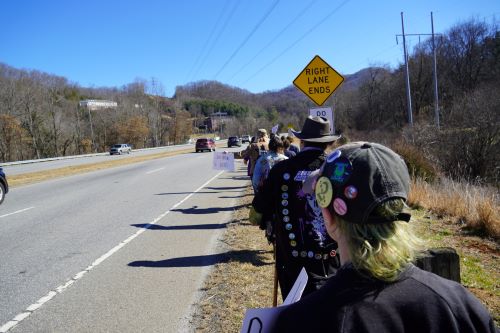
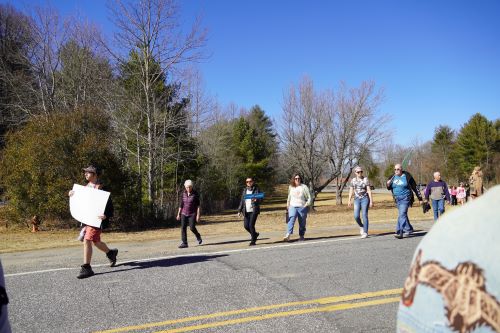
Cars speed down the busy four-lane highway, some drivers honking in support while others leaned out their windows to heckle as more than 50 WCU students marched along the shoulder toward the nearest early-voting site on Feb. 13.
The march comes after the controversial decision by the Jackson County Board of Elections to eliminate the on-campus early voting site at WCU, a staple since 2016. After this, WCU students filed a lawsuit citing that it violated their right to vote. The case went to the NC State Board of Elections where the motion to replace the voting sites at WCU was denied. With this denial, the nearest early voting site is now at the Cullowhee Recreation Center, 1.8 miles away from campus.
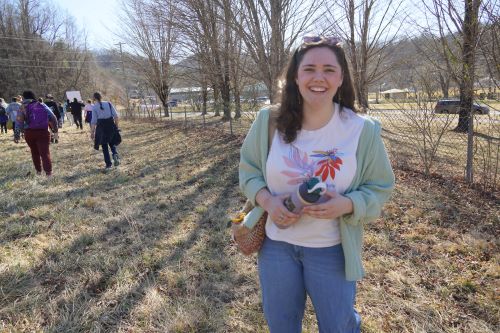
“I believe that the dismissal of the voting stations on campus at Western Carolina University was an act of voter suppression,” said Lauren Sawyer, an international studies and political science major as well as the president of WCU’s international studies club.
Sawyer was one of the students marching and said this issue was personal for her because she, like many other WCU students, does not have a car. She had voted at the previous University Center voting place many times and was planning on voting at it again this year until the Board of Elections decision.
WCU’s Center for Community Engagement and Service Learning has arranged a shuttle that will take students to the Cullowhee Recreation Center from the UC. The shuttle service runs on 30-minute cycles weekdays from 12 p.m. to 5 p.m. until Feb 27.
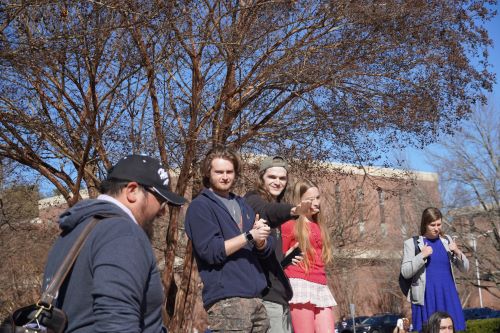
President of WCU’s College Democrats, the club that organized the march, and plaintiff in the lawsuit Zach Powell emphasized that CCESL’s voting shuttle did not exist when the board made their decisions.
“We felt it was important to demonstrate how difficult and inconvenient the walk is for students who may not be able to take advantage of the shuttle service during its hours of operation,” Powell said.
The early-voting site in Cullowhee Recreation Center was not prepared for the influx of voters that came with the march.
““They were not prepared for such a large group to come in, they are having to take time to do same day registrations because those do take time,” said Brandon Teague, the treasurer of WCU’s College Democrats and a political science and history major. “They are having to do five at a time because the voting rooms are so small that’s it’s due to fire capacity.”
Just like Sawyer, Teague does not have a car. He explained that he is enrolled in 18 credit hours as well as works two campus jobs, making it very difficult to vote at the new site.
“Luckily, I made time today because I am going to vote. Nobody sitting behind a desk either in Raleigh or here in Jackson County is going to stop me from voting,” Teague said.
The students were joined by supporters of their movement, including candidates in Jackson County’s Primary Elections; John Herrera, Bobbi Hope and Casey Walawender, as well as elected officials; WCU English professor and Town of Webster council member Brad Reisinger and Lindsey Prather, a member of NC’s General Assembly.
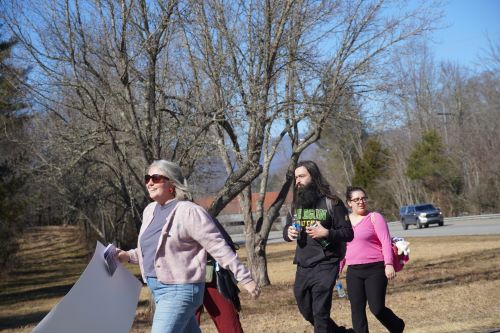
“The very first time that I voted was as a Western student. So, students being able to vote feels really significant to me,” Walawender said. “I’m really upset that our state is going after college campuses as another means of voter oppression.”
Like the other students mentioned above, Walawender did not have a car when she went to WCU. According to Walawender it is well-known that many WCU students do not have cars and that was the intention in removing the WCU early-voting site, to make it harder for students.
Walawender added that the walk to Cullowhee Recreation Center was not a pleasant one.
“It’s a long walk. It’s not an easy walk and it’s not a safe walk. So, you are in the grass, or you are on the highway, neither of those are designed for students to be walking,” Walawender said.
While the Board of Elections argument for removing the voting site was to save money, Walawender disagrees. According to Walawender, it is an attempt to silence college students’ voices.
In the reasoning for the removal of the WCU early-voting site, the board cited cost concerns. Jackson County Board of Elections Chair Bill Thomspon argued that having two early voting sites so close was a waste of taxpayer’s money. Thompson said getting rid of the early voting site would save the county board $20,000, yet another board member, Betsy Swift, said it would be closer to $6,000.
Another student, president of WCU’s Revolutionary Book Club Max Lynch, has slightly differing thoughts.
“It’s just like they wanted to save $6,000. They wanted to defund democracy. That’s the goal,” Lynch said.
Lynch marched to the polls with the other students and voted. They echoed Teague’s sentiments that Cullowhee Recreation Center was wholly unprepared. According to Lynch there were four election officials two voting booths. It took almost 45 minutes to get the group of students through.
While Lynch is grateful for the voting shuttle provided by CCESL they acknowledge it was still inconvenient.
“What’s the difference between walking seven minutes to the UC to vote or walking seven minutes to the UC to be picked up by a shuttle in 15 minutes, to be driven five minutes down the road, to be dropped off, to take however long to vote, because now the two voting sites are put together,” they said.
Lynch also acknowledged that in the past, when the voting site was at the UC, there were arrows and chalk on the ground directing students to go vote. With the voting shuttle, they argue, you must actively seek it out.
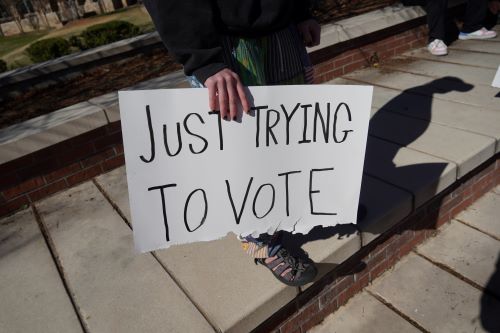
A common sentiment with the march is that students are resilient and will still go vote, even with the removal of the on-campus site. Yet, Lynch disagrees. They argue that with this removal, the people who do not care as much about politics most likely will not go find a way to vote.
“If access gets harder, less students will come,” they said. “And that’s what we’re going to see when the election data comes out, when we see the total number of votes from last period to this one. We’re just going to see a drop-off.”
WCU’s College Democrats are offering a separate shuttle to Cullowhee Recreation Center on Feb. 21 and 28, for the weekend days the CCESL shuttle will not be running. The shuttle will be running from 10 a.m. to 3 p.m. with pick-up and drop-off outside of the UC, near the mail room and Cat Tran stop. There will be a waiting room in the UC Raleigh Room.