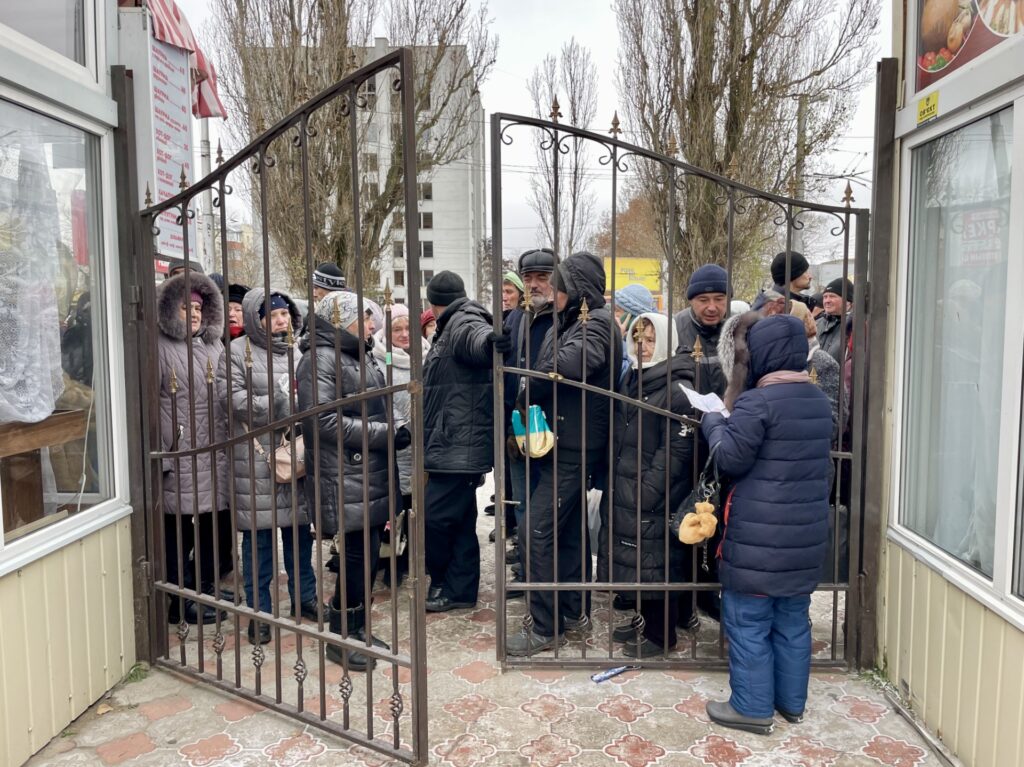
A local reporter went to the front lines of Ukraine for two weeks in December 2022, a trip that changed his perspective on journalism forever.
Born and raised in Chicago to a Ukrainian mother, journalist Cory Vaillancourt originally wanted to become a lawyer. However, after working as a field organizer for Al Gore’s 2000 presidential campaign in Boulder, Colorado, Vaillancourt realized he was more interested in politics than law when he came to Chicago.
“I said, ‘I don’t want to be a lawyer anymore. I want to do this,’” Vaillancourt said to WCU’s international reporting class when he talked to them in early September.
For the next ten years he ran political campaigns across multiple states for both parties, before eventually coming to NC with his wife.
Years later, while in Pennsylvania, some people Vaillancourt knew asked him to write the politics column for their newly created paper and within six months he was one of their editors.
These experiences led him to Smoky Mountain News where he serves as the politics editor and covers county governments, school boards, commissioners, town boards and more.
Vaillancourt first reported on the Russia-Ukraine war when the war broke out. For that story he talked to WCU professors Katerina Spasovska, Ingrid Bego, Niall Michaelsen and David Dorondo.
The article, The messiest story you can have offered a western perspective on the Russia-Ukraine war.
A month later, Bego sparked an idea in Vaillancourt’s mind – why not go to Ukraine and see for himself? He immediately began planning to go that summer, until all those plans fell through.
Bego came through again, telling Vaillancourt about a man in Asheville who was shipping humanitarian aid to Ukraine.
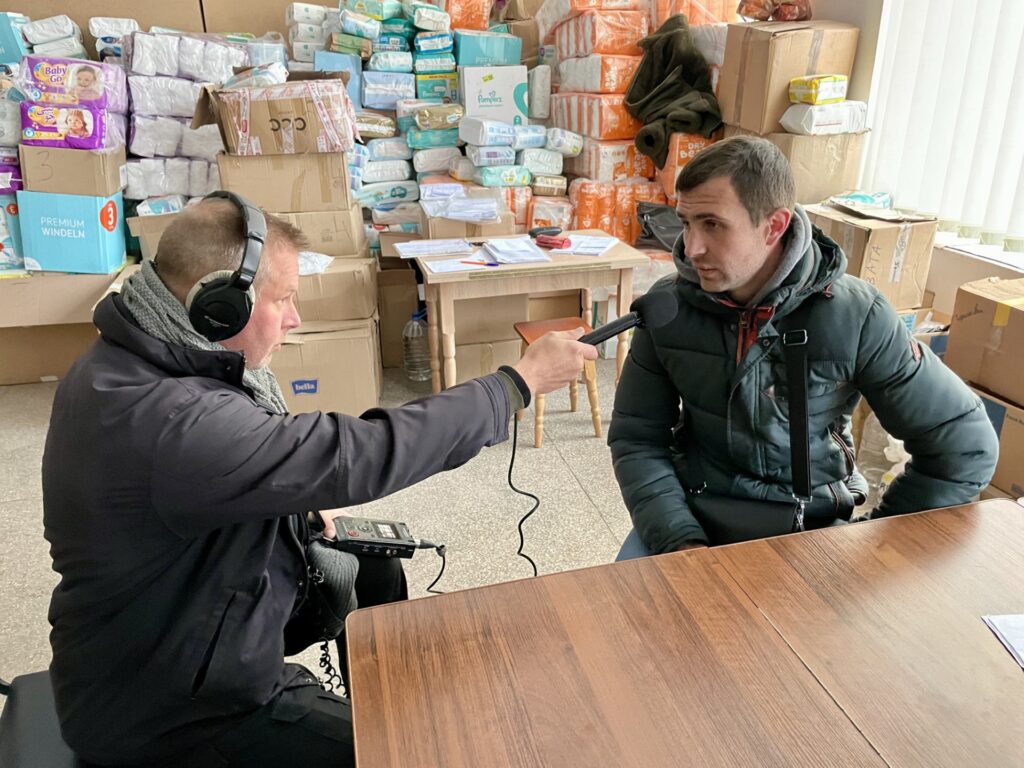
“She said, ‘You need to call this guy,’” Vaillancourt said. “Within five minutes I knew I was going. He asked me to bring expired body armor to some relief workers in Ukraine.”
Vaillancourt’s plans were back on. He decided he would use his saved-up vacation time with Smoky Mountain News to go to Ukraine in winter, with the hope of collecting some stories while there.
“I scraped up my money. I did this on my own dime,” he said. “I bought a plane ticket. At that time, it was super cheap because it’s December and who goes to Eastern Europe in December?”
Vaillancourt flew to Krakow, Poland which was the nearest city to the Ukrainian border. Once there, he made his way to Odessa where he met up with a former contact from when he worked in the Al Gore campaign who had since become an international development and aid worker.
“He’s worked for a variety of organizations that administer U.S. taxpayer-funded aid in disaster zones,” Vaillancourt said. “He said, ‘I want to get off the road, I’m done.’ Well, he took another job in Ukraine.”
While Vaillancourt’s contact was in Ukraine he met a woman and married her. His girlfriend became Vaillancourt’s fixer, a guide and translator who could help navigate the region safely.
“She was working in marketing when the war started and lost her job,” Vaillancourt said. “(She) devoted herself to relief effort, trying to help organize whatever she could for Ukrainian troops.”
Vaillancourt’s first story from Ukraine, Bringing help documented the delivery of the expired body armor to the relief workers in Ukraine. According to Vaillancourt, he delivered the luggage to the Ukrainians early in the morning and never saw the man he delivered the bags to again. Eventually he did get a photo from the man he was in contact with from Asheville and the picture confirmed the body armor Vaillancourt delivered had gotten to where it needed to go.
“So I knew it had made it to the people that it was designed for. So I enjoyed that. I felt good about that,” Vaillancourt said.
The second story. Bringing hope, focused on U.S.-funded aid through Project HOPE, a humanitarian organization. Vaillancourt went to Kherson for this, a city that had been under Russian occupation for eight months and liberated by the Ukrainians for around two weeks when he arrived.
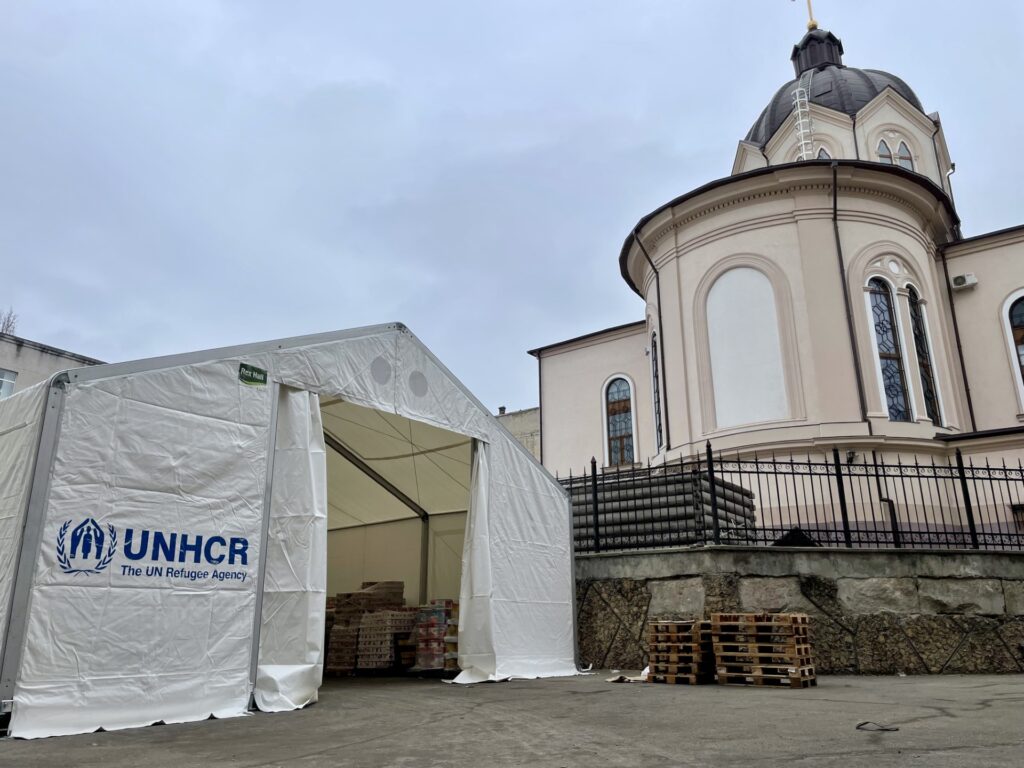
Vaillancourt joined Project Hope aid workers in distributing supplies like razors, soap and feminine hygiene products at a Ukrainian maternity hospital.
“It functions almost as a community center,” Vaillancourt said. “Two weeks after I got back (to the US), Russians blew up that maternity hospital with a missile.”
He also visited a former wood shop where families had hidden from Russian soldiers during Russian occupation. Project Hope and Vaillancourt passed out boxes of aid at the wood shop.
“There were hundreds of people standing outside looking absolutely broken,” said Vaillancourt. “Absolutely broken.”
At one point at the wood shop Vaillancourt and the people he was with had to take shelter in a bunker on the property. The bunker had about 10-15 people living there, according to Vaillancourt. The Ukrainians had rigged up hot water, had a hot plate, a shower, primitive sanitation facilities and cooking and eating facilities in the bunker.
“I look over and there’s children’s toys. That was my first clue that children live here,” he said. “One of the toys was like toy tanks. I thought, ‘oh wow, that’s ironic.’”
While in Ukraine, Vaillancourt dealt with constant power outages, making his reporting difficult.
“You’ve got to work when there’s power, charge when there’s power, and sleep when there’s not,” Vaillancourt said.
At one checkpoint, Ukrainian soldiers questioned the group he was traveling with because they did not recognize Vaillancourt. During the questioning Vaillancourt overheard the guard mentioning journalists, causing him to fear that his equipment might be seized. This fear is a legitimate one since in combat zones journalists are often targeted.
“I swapped out (a memory card) and I jammed it in part of the car, in the upholstery or something. And then I swapped in a blank one,” said Vaillancourt. “But I was nervous. I know in a lot of the world journalists are threatened and feel that way and you have to hide all of your stuff. All of that was a really new concept to me.”
To prepare for the risks in travelling to an active war zone, Vaillancourt sought advice from contacts who lived in or had been to Ukraine. All of them emphasized the importance of knowing how to use a tourniquet.
“The whole day when I was there working, out of nowhere, (Vaillancourt’s friend) would just yell and fall down on the ground. And it was my job to immediately get to him with a tourniquet and apply it correctly,” Vaillancourt said.
He also learned to keep snacks and water in case the group’s car broke down, or they got stuck.
“You have to prepare for the unexpected because there’s nothing you can do when you’re running out of water and waiting for repairs or when your van gets blown up and everybody’s gravely injured and you need things and you don’t have them,” Vaillancourt said.
For Vaillancourt, the mental preparation to go into a hostile environment was simple.
“When you go into a situation like this, you have to reckon with your mortality and say to yourself, there is a possibility I die here,” Vaillancourt said. “If you’re not comfortable with that, don’t go.”
At a Global Spotlight Series panel at WCU, Vaillancourt discussed his experiences in Ukraine and discussed how the war has changed four years after Russia’s full-scale invasion.
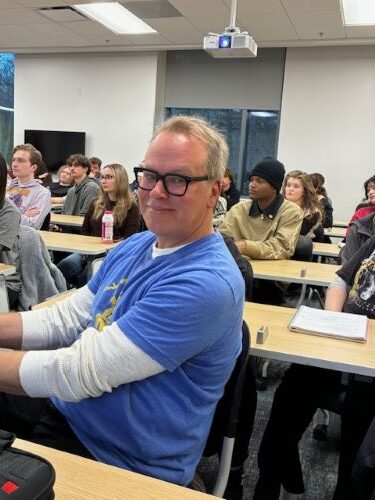
While describing his experiences in Ukraine, Vaillancourt recalled the constant presence of war around him.
“(There was a) constant drumbeat in the background,” he said, referring to the sound of artillery fire near the front lines.
During the panel, Vaillancourt described several ways the war has evolved, including changes in humanitarian aid, civilian morale and new military technology.
He outlined three phases of humanitarian aid. Phase one occurred immediately after Russia’s invasion, when humanitarian aid was focused on life-saving assistance. In phase two, efforts shifted toward repairing damaged infrastructure and supporting overwhelmed municipal systems. Now Vaillancourt says, the war is in phase three which is marked by continued attacks on infrastructure and prolonged power outages.
Early in the war, it often took Ukrainians longer to repair infrastructure since they had never done it before. Eventually, Vaillancourt said, repair crews adapted.
Now, however, Russian forces carry out “double-tap” strikes or attacking the same location twice, which kills experts who arrive to repair damaged systems.
Vaillancourt also said morale among Ukrainians varies depending on developments in the war. At the time of the panel, he said many Ukrainians are excited since there have been Russian communication errors and Ukraine is making gains.
“No one is willing to accept surrender just for these luxuries, these modern luxuries we take for granted,” Vaillancourt said, emphasizing the resiliency of Ukrainians.
According to Vaillancourt, one of the most significant changes has been the rise of drone warfare. When the war first broke out, drones were rarely used. However, rapid innovation by both Ukrainian and Russian forces quickly made drone warfare a norm.
Vaillancourt said the rise in drone warfare is likely to have changed modern warfare.
He concluded by reflecting on a post-war Ukraine, one where Ukraine may very well become one of the most experienced in drone technology and disposal of unexploded mines left behind by the war.
“One day, it will be over,” Vaillancourt said.