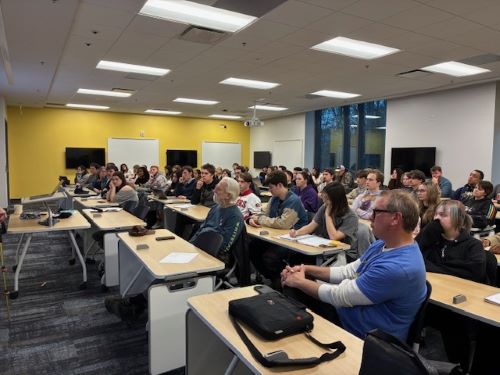
As Russia’s war against Ukraine reaches its fourth year, WCU’s Global Spotlight Series hosted a panel of experts to discuss what has changed in the four years since Russia’s full-scale invasion of Ukraine.
One of the panelists was Cory Vaillancourt, a reporter at Smoky Mountain News who went to Ukraine in late 2022 and the summer of 2023 to report on the war and visit friends. During his section of the panel, Vaillancourt talked about the main changes he’s seen in Ukraine since he went. He highlighted changes in aid given to Ukraine, infrastructure repair and drone warfare.
Another panelist was WCU history professor David Dorondo. Dorondo’s talk focused on how Russia’s war extends beyond the borders of Ukraine.
“Russia’s waging war, not just against Ukraine, but against the whole of Western Europe. Countries whether they are in NATO or not, whether they are in the EU or not,” said Dorondo, during his lecture.
He used Germany as a case study, highlighting the importance of Germany being in the middle of Europe. Due to its positioning, Dorondo said, military supplies traveling from Western Europe to Ukraine or the eastern flank of NATO will go through Germany.
According to Dorondo, it is because of this that Russia has been engaging in hybrid warfare against Germany. In Germany this manifests as cyber-attacks against critical infrastructure like railways, power grids and factories, physical sabotage on NATO fuel pipelines and navy warships, and assassination attempts.
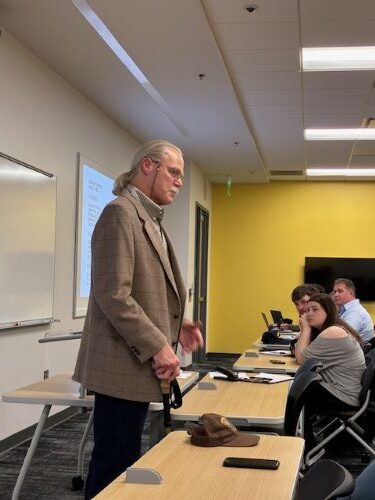
Dorondo also detailed Russia’s strategies against Germany, Europe and NATO. He said in Germany the strategy is to disrupt politics, social organizations and economic productivity. In Europe it is to sow chaos overall, and for NATO it is to decouple the U.S. from NATO and Europe. According to Dorondo, Russian state actors, German organizations that sympathize with Russia and social media all help with these goals.
Dorondo ended his lecture by stating his belief that as long as Vladimir Putin is the president of Russia, the war will continue.
“Whenever the war in Ukraine does end, I think he’ll sort of regather his strength for round two, either against Ukraine, or against the Baltic states, or Moldova or some other place,” Dorondo said.
The third panelist was Charles Fagan, a political science professor at WCU. Fagan’s section of the panel focused on nuclear proliferation and threats.
Fagan referenced the threats Russia has continuously made against the United States and other NATO countries if they were to help Ukraine. Putin and other Russian leaders have repeatedly warned that any NATO intervention will lead to a full-scale NATO war, which would also heavily feature nuclear weapons.
These threats have made it so Ukraine’s allies are extremely reluctant in the aid Ukraine has requested. According to Fagan, Ukraine has had to ask for aid in the form of weapons repeatedly. The delay on military aid raises concerns of global security.
“What will this do to other countries who could face a nuclear power attacking?” Fagan asked. “Can they rely on U.S. support if the U.S. can be deterred from strong intervention by a nuclear power?”
According to Fagan, these fears may push more countries to consider developing their own nuclear weapons.
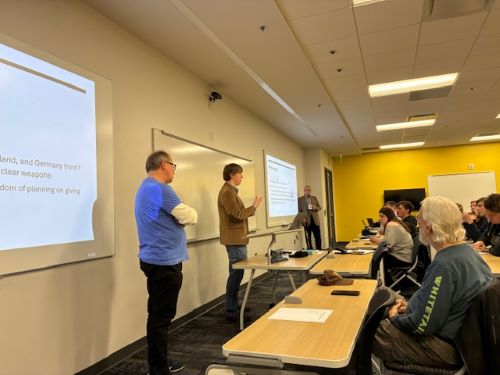
At the end of the panel, students asked the three panelists questions ranging from what daily life in Ukraine is like to the U.S.’s involvement in it.
When asked what daily life looks like for Ukrainian civilians, Vaillancourt pointed out the differences between rural and urban areas. He said for the rural areas of Ukraine, life is like the U.S. in the 1940s, with very basic supplies and a focus on agriculture.
For the people living in the city, Vaillancourt said, there is no cell, electricity or hot water. He emphasized the importance of power banks for charging phones, and that many Ukrainians would sleep when the power was out and charge their phones when the power came back.
“Life is noisy and stinky,” Vaillancourt said, adding that civilians were living under military curfew and martial law as well.
Another participant asked whether the war could escalate into a widescale NATO war. Fagan responded it wasn’t unavoidable but that it has become more likely.
One student asked whether the monetary aid allocated to Ukraine from 2022-2024 was in the best interest of U.S. citizens. All three panelists said they believed the funding was justified.
Vaillancourt emphasized that not all of the monetary aid had been received by Ukraine yet, and acknowledged the broader stakes of the conflict.
“If you care about America, you need to care about Ukraine because right now it’s your money,” Vaillancourt said. “In a generation or two, it’s going to be your children.”
Fagan added that lots of the money allocated by the United States went to giving Ukraine its old equipment and buying new equipment for the U.S. military.
Dorondo emphasized what he called a “moral clarity” when the full-scale invasion happened.
“Somehow along the way, we have sort of conflated who the victim is and who the aggressor is, in the minds of many people,” Dorondo said. “This is an unprovoked war of aggression by a large country against a small one.”