The University of North Carolina school system has recently adopted a new definition for academic freedom. Even as a proposal, this sparked discussion among faculty and administrators regarding its potential impact at Western Carolina University.
Previously, WCU along with other universities have relied on the definition brought by the American Association of University Professors (AAUP) in 1940.
The new definition approved by the UNC System Board of Governors offers a clearer definition that will affect teachers and students in the classroom differently says WCU General Council, Shea Browning.
“It changed in that there’s actually a definition now,” said Browning. “It was just kind of implied before.”
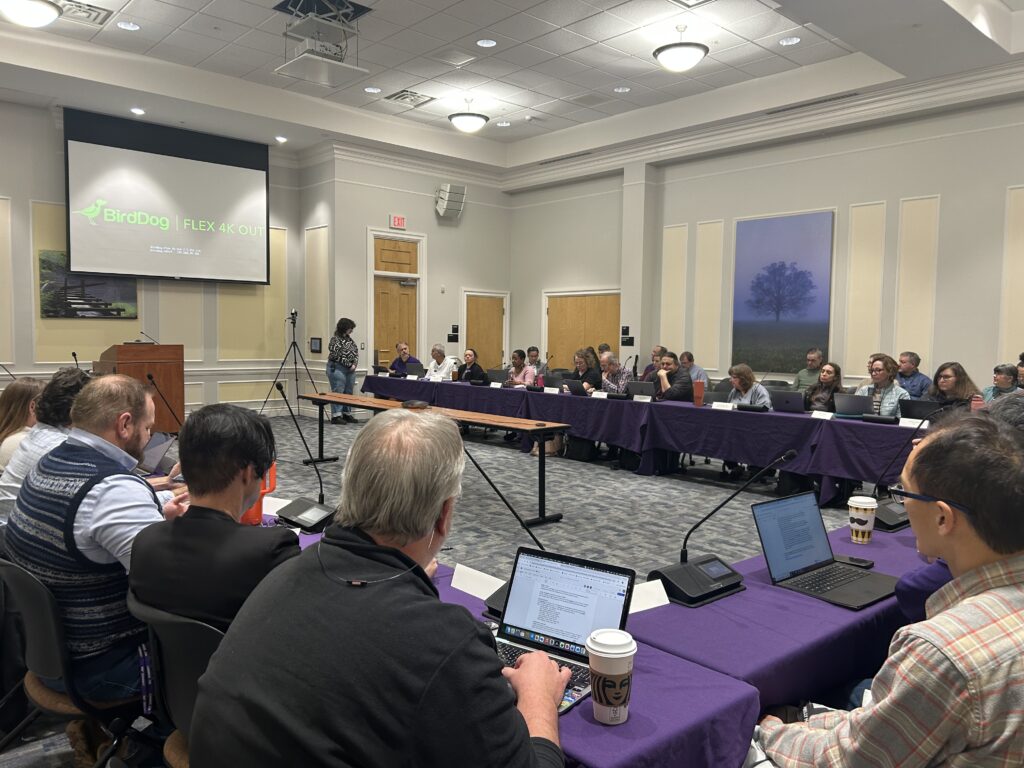
At the WCU Faculty Senate meeting on Feb. 25, Dr. Todd Collins led the discussion of this new academic freedom definition. He discussed the edits and criticism from the November proposal to the final definition.
Collins shared how WCU passed their part of the new academic freedom policy and emphasized how the wording regarding faculty remained relatively the same from November, but the student side faced some changes. His information was reported in the UNC System Faculty Assembly report.
“I raised some issues with the language that was in there, which is now marked out. That language was, ‘students are free to take reasoned exceptions to concepts and theories presented in their classes and can disagree with the opinions they hear from their faculty member,’” said Collins. “I think my concern was that there isn’t much context to that, and what does that really mean.”
“What we got in the new version may be worse or may be better. But now it reads, “has a protection of freedom of expression in classrooms. Students may exercise freedom of expression, in the classroom, period,” added Collins. “And that’s all it says. Again, there’s no context there.”
Collins went to explain how there has been push back on this proposal from many faculty members like David English, Senior Vice President for Academic Affairs, and Fred Sellers, Vice President for Safety and Emergency Operations concerning the extent of student’s academic freedom rights and classroom effect.
Collins ended by saying the ambiguate guidelines were written to be flexible, so each university can implement what they think is right, especially regarding classroom syllabuses and requirements.
The new policy approved on Feb. 26 defines academic freedom as, “the foundational principle that protects the rights of all faculty to engage in teaching, research/creative activities, service and scholarly inquiry without undue influence. It ensures that faculty can freely pursue knowledge; express, discuss and debate ideas; and contribute to knowledge and understanding related to their areas of expertise.”
This policy has prompted discussion regarding its impact on teachings and classroom participation. It can be expected that faculty and students will test their limits to find the actual changes because the language remains vague and complex.
“It’s not as simple as just, now a student can say whatever they want in class, but I do anticipate there’s going to be some pushing of that boundary,” said Browning.
When asked about the proposed definition for academic freedom and the implication at WCU, Faculty Senate Chair Basel Alsayyed Ahmed said, “I’m not planning to give any statement,” via email.
The disagreement regarding this definition focuses on whether this will be a step forward or back. One side believes a concrete definition will help faculty and students know their exact limits and privileges. On the other hand, some believe this policy can be considered censorship on education.
The previous definition from 1940, was agreed upon by the AAUP and the American Association of Colleges and Universities (AAC&U), and has served as the foundation for higher education across the United States since.
Vincent Russell, assistant professor in Western Carolina University’s Department of Communication and president of the WCU chapter of the American Association of University Professors criticizes this new definition for its potential impact in the classroom.
“Within the professional standard, it says that course material needs to be clearly related to the academic disciplines,” said Russell. “And basically, that opens faculty into disciplinary procedures for things that people perceive as not supporting the mission of the university.”
This definition also opens room for students to disrupt crucial class time for those who might object to certain topics being taught. This may negatively affect the students, the accused faculty, and other classmates.
“The example I’ve been using is an English professor. You might think their sole job is to teach English, but if they assign a novel about climate change, they’re also going to be teaching about climate change. Then, someone could critique and say that they’re only an English professor and don’t know about climate change, which can lead to disciplinary procedures,” said Russell.
While the long-term effects of this new definition for academic freedom are unclear, faculty and administrators expect to see this development when used in everyday classrooms at WCU.