Women’s History Month is often used to highlight figures who fought for equality and changed history. Historian Elizabeth McRae said that focus only tells part of the story.
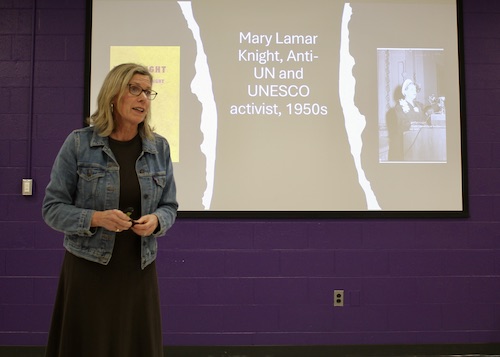
McRae, an associate professor of history and the author of “Mothers of Massive Resistance: White Women and the Politics of White Supremacy,” spoke at Western Carolina University during a program hosted by the American Association of University Women.
Her research looks at how white women shaped political and racial systems in the 20th century.
“We’re at a stage now that women as a category is much more diverse than the early historians who were trying to get women in the historical record,” McRae said.
She said that approach helped to get women into the historical record, however, it left out a lot of other stories as history tends to focus on the positive.
“That sort of early stage, particularly about American women’s history, was so much about like the sort of heroines of history,” she said. “Like, who campaigned for the right to vote, who freed enslaved people, like Harriet Tubman, and who challenged systems.”
McRae’s research focuses on the women who are left out of recognition, including white women who worked to uphold segregation and racial inequity during the Jim Crow era.
“They aren’t working in these rural communities, and they’re savvy local political activists,” McRae said. “We often think about activists as people working for a more just society, but the segregationists that I’ve read about are white women who are activists for a society built around the ideas of white supremacy.”
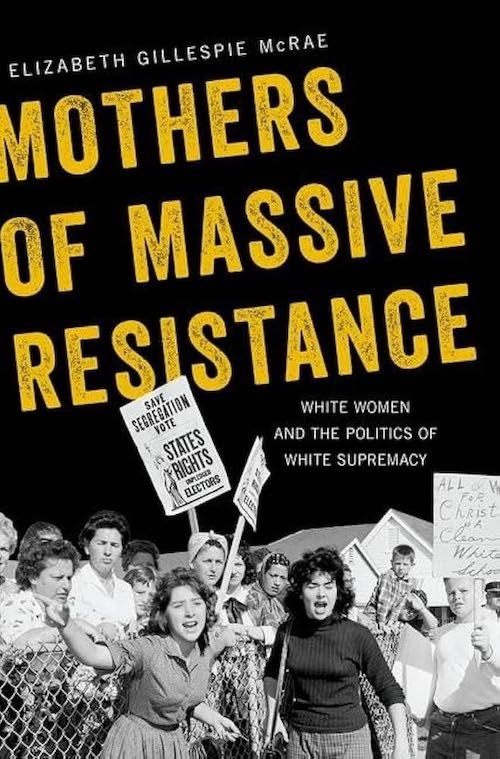
In her book, “Mothers of Massive Resistance,” McRae argues that white women were central to upholding segregation because of their roles in education, politics and culture. She focused on the rooted networks of women that influenced how race and history were understood in the classrooms.
“They work in public and social welfare offices beginning in the 1920s to uphold white over black,” she said. “They work in public education, establish political networks and organizations, and participate in the cultural work of Jim Crow storytelling.”
That work soon went into schools and textbooks. In the early 1900s, educator Mildred Lewis Rutherford and others pushed for textbooks that promoted a specific version of Southern history, often focusing Confederate leaders while downplaying slavery and racism.
“By flipping one committee, they flip the history that children across the United States are taught,” McRae said. “So, what disappears? Harriet Tubman disappears. Nathan Bedford Forest, who started the Klan, disappears. That had been in the textbooks in the 1890s, it’s not in the textbook by the 1920s.”
McRae expanded on this censorship of history in a Poverty and Race article.
“Faced with the demands to desegregate the nation’s schools, white segregationist women had turned their efforts to creating a curriculum that upheld white supremacy, censored what they deemed as radical thought, and erased Black history,” she wrote. “They knew history mattered and that the history students learned could reinforce the status quo or challenge it.”
McRae also wrote about how this battle over history continues today.
“A new generation of segregationists have returned to the censorship of curriculum materials and library books, the inculcation of white supremacist teachings and the erasure of Black history,” she wrote. “It teaches the nation’s students that a whitewashed history of the nation is ‘the’ history leaving them unequipped to challenge persistent and corrosive inequities.”
Mcrae said the amount of effort behind this work shows it was not unchallenged.
“The very fact that white women have to work so hard at this and in so many places, suggests that their work is being contested,” McRae said.
That history is part of what Women’s History Month is meant to reflect. The recognition grew over time as more people pushed to include women’s contributions.
Its roots trace back to March 8, 1857, when women working in factories in New York City protested poor working conditions. More than 50 years later, the first National Women’s Day was held in the United States on Feb. 28, 1909.
By 1911, International Women’s Day brought more than one million people to rallies worldwide, and in 1975 the United Nations officially recognized March 8 as International Women’s Day.
In the United States, the movement continued to grow. In 1978, educators in Santa Rosa, California organized the first Women’s History Week to highlight women’s contributions in schools. President Jimmy Carter proclaimed National Women’s History Week in 1980, and Congress made it an annual observance in 1981.
By 1987, that recognition expanded to the entire month of March.
McRae said studying both the women who challenged inequality and those who upheld it helps create a more complete understanding of the past.
Women’s History Month is not just about celebrating well-known figures, but about understanding how women have shaped history in different ways and why that still matters today, says McRae.