How journalists cover democracy may matter less than the readers’ political identity, according to a guest speaker at WCU on April 6 as part of the Haire Speaker Series.
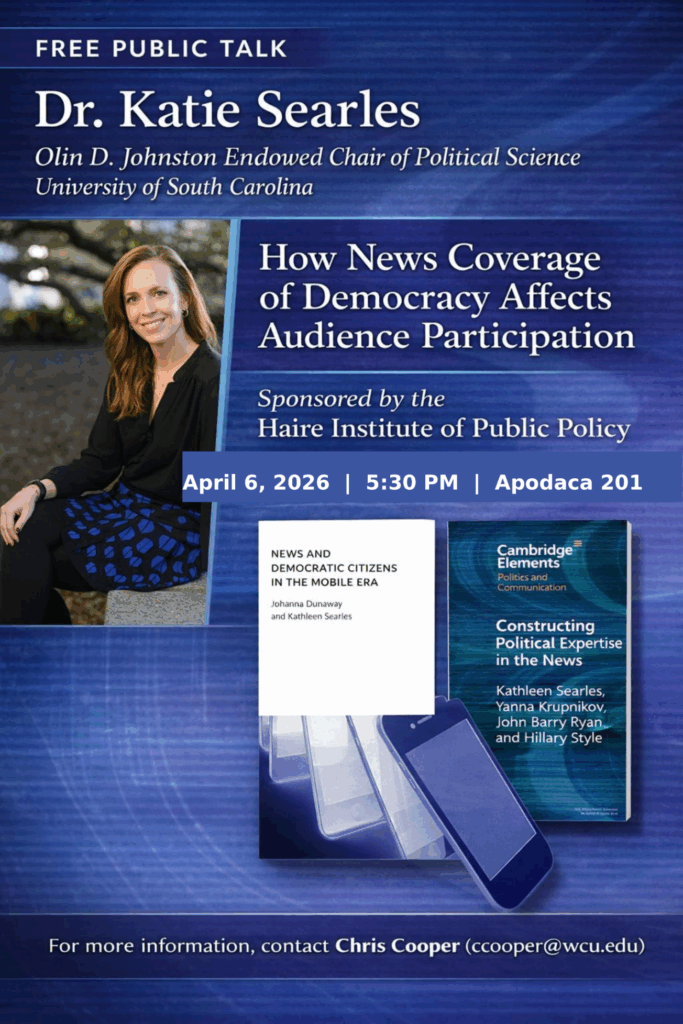
Dr. Katie Searles, the Olin D. Johnston Endowed Chair of Political Science at the University of South Carolina, presented her research about democracy coverage to students at Western Carolina University on Monday, April 6. Her talk titled “How News Coverage of Democracy Affects Audience Perceptions” attracted many students and community members.
“Dr. Searles is an internationally known scholar who does work that intersects not just with the academic world, but with the world of practical politics and governance,” wrote Chris Cooper, political science professor and director of the Haire Institute for Public Policy. “She’s the perfect fit for the Haire Speaker Series.
Searles started her talk by discussing the challenges for news organizations in covering democracy, highlighting both journalistic constraints and the public’s view on democracy.
She explained that newsrooms deal with economic, institutional and psychological constraints. They must have consumers to survive financially, journalists operate within a series of internal norms and expectations, and increasingly, people avoid the news. Searles explained these factors all create barriers for newsrooms that need to make money.
“News is the broccoli equivalent of information. It’s very much understood that we need it, that we should probably consume it, but you maybe don’t really like to,” Searles said. “We know that particularly younger folks do not consume news at very high rates.”
The second issue Searles addressed is that while it is a strong consensus in the United States that democracy is threatened, only 7% of people think that the potential threat is an important problem. She said this tension makes it even harder for reporters trying to deliver a product.
Searles began her experiments and research with the aim to find the right frame in democracy coverage that would lead to more people consuming it, but after three studies she came to the conclusion that partisan identity is the key driver in how people respond to democracy coverage.
“It is all driven by partisanship,” Searles said.
Searles and her partner, Yannah Krupnikov, conducted their experiments by presenting readers with different versions of news articles and measuring their response. Throughout the studies, the conditions for emphasizing democracy changed, but the outcome did not. However, Searles noticed a strong partisan divide in trust for the news.
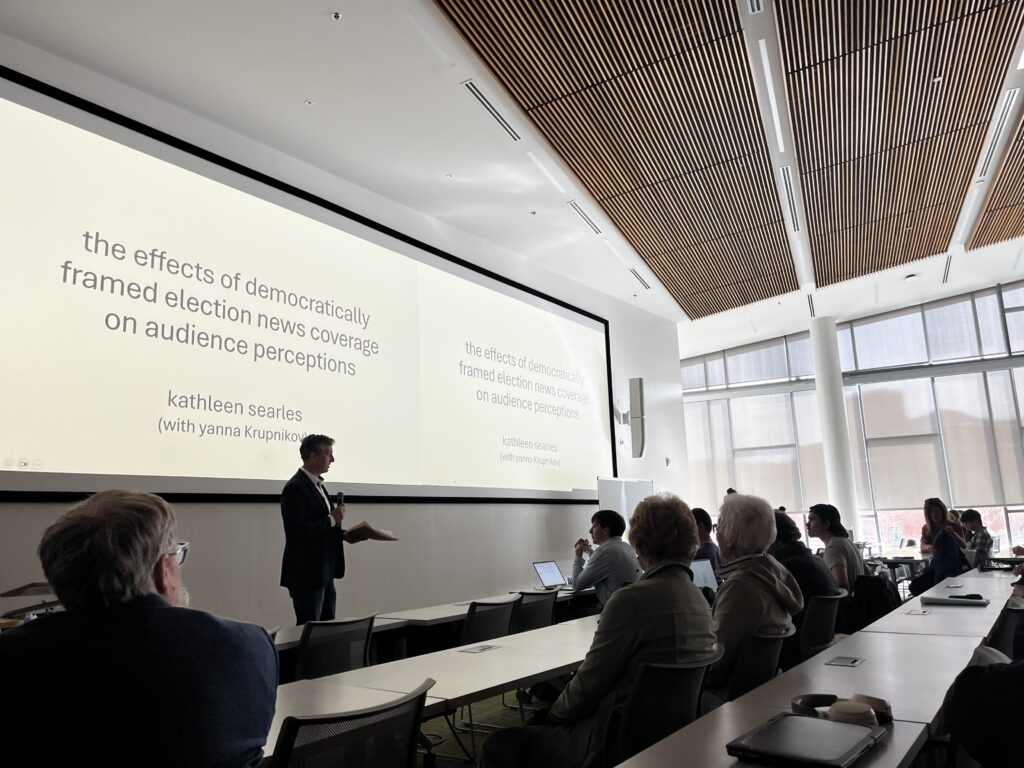
“Democrats liked all the conditions,” Searles said. “Republicans didn’t like any of them. So it didn’t really matter whether we said democracy or how we said it, it was just blanket disregard or regard for the news.”
She attributed one of the reasons for the partisan divide to the way people tend to rationalize the way they think about democracy. Searles pointed out that people in the U.S. are socialized to see democracy as the best way to do things and if the political party someone is a part of is perceived as violating those ideas, that person will try to make up a justification for why that is.
“It makes a lot of sense considering it takes a lot of labor to rethink your partisan identity, to rethink your political attitude,” Searles said. “Rather than engage in the sort of the mental gymnastics of justifying whatever happened, (the consumer) just doesn’t have to read the news.”
Searles recognized the problems that arise from a large portion of the population just refusing to read the news.
“We don’t necessarily want people to stop reading and seeking news because they perceive it to not be for them, that doesn’t seem great for democracy,” Searles said, while asking the question of how to inform people about democracy in a way that they perceive it to be for them.
As a possible solution or examples, she offered something like voting process coverage. Voting process coverage focuses on explanations of how elections or politics work but does not necessarily emphasize democracy.
During the question and answer section of the talk, attendees asked questions related to declining trust in media, rhetoric about media from both political parties,
One student asked when the media industry should deserve blame for more and more people turning away from news, specifically Republicans.
Searles responded that at the larger big corporate media level, this dynamic is unfixable. She added, however, that this is a change that could be accomplished at the smaller, local level and that consumers should reward that behavior by consuming that news.
Another student asked about the differing rhetoric from the Republican and Democratic parties and if that could be why more Republicans turn away from the media, to which Searles said she suspected that to be the truth. She added that this weaponization of distrust in media, seen more often from the right than the left, could be why Republicans turn away when they see the word democracy in media.
“We actually suspect that part of what happened is that we’ve had a couple of presidential elections now where democracy in crisis has been sort of a rallying cry, and that the effect of that has been perceived to be politicized,” she said while answering a student’s question about the potential success in changing the word democracy to something else.
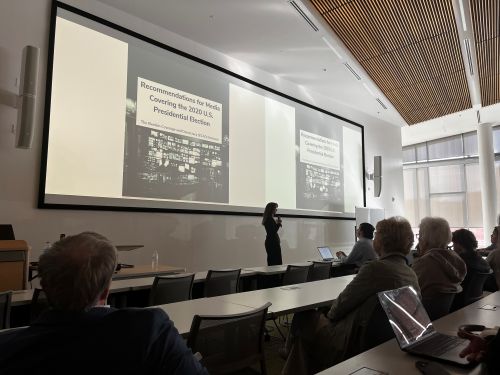
She urged attendees to consider all the other factors when it comes to covering democracy, rather than making blanket assumptions or recommendations.
“We should think more about how people actually perceive the news,” Searles said. “And deliver recommendations that meet journalists where they’re at and meet the public where they’re at.”