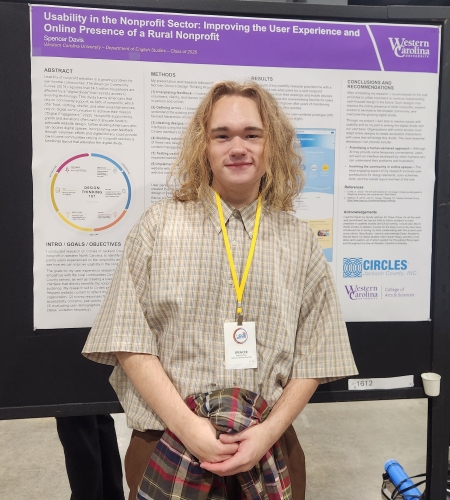
Spencer Davis, a senior English major at WCU, saw a need for a human-centered, user-friendly website to provide greater access to services during his internship with Circles of Jackson County.
Davis and Drew Virtue, a professor in the English Department at WCU, worked together to improve the Circles of Jackson County website to help more people understand how to use their services.
Davis presented his research at the National Conference for Undergraduate Research in Richmond, Virginia, on April 15. He also presented the study in poster-form at the Research and Scholarship Conference at WCU on March 25-26 of this year.
“The theory or hypothesis I developed for this study was that organizations that involve stakeholders in the design process will produce a human-centered design that relieves the pain points users commonly experience with inaccessible designs,” Davis explained. “For nonprofits, involving clients, donors, volunteers, and staff alike will create a desirable user interface that the actual target audience of the website want to use.”
Davis explained that one of the problems in society is the digital divide between people that understand the workings of technology and those that don’t know how to use it, preventing them from having access to needed services. Davis offered a solution by integrating user needs into the design and functionality of the websites as evidenced by his work on the Circles of Jackson County website.
He adapted what he learned in Virtue’s class on UX writing, also known as user experience writing, into his research project and was able to begin implementing it in his work with Circles.
His goal was to involve as many people as possible in the project, from utilizing surveys and interviews to designing, testing and implementing it onto the website.
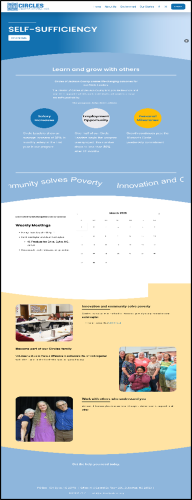
“I surveyed folks in-person anonymously, as a group, created a Google Form and put it on the website, interviewed randomly selected individuals who fell into the three main categories of my research (donors, clients, students), and even brainstormed with users for how the final design should look,” said Davis.
The surveys gave Davis ideas about changes that needed to be made to the Circles’ website to make it more accessible to users. He worked with five users to directly test their experiences with the website design and recorded the results in a digital format for the organization to have access to.
“I also concluded that digital usability is a cycle of constantly improving areas where users may struggle with technology,” Davis said. “What we see as standard web design was not the case five years ago, and online user bases will always grow, change, and evolve, as will their desires.”
Davis said he hoped the study would get more people to think more deeply about web design and to consider the influence common people have on how nonprofits, corporations, government agencies and media portray themselves on the internet. He wanted his research to emphasize the importance of creating websites with a human-centered approach instead of focusing on AI to build a site that would not be aesthetically pleasing and easy for people in every demographic to use.
Hear what Davis said about his project.