The story was published in The Sylva Herald, April 23
Story was co-written with Ashley Lind
NASA accomplished something historic on April 10. The Artemis II mission to orbit the Moon and come back in 10 days was successful and as NASA says on their website “the first crewed Artemis flight marks a key step toward long-term return to the Moon and future missions to Mars.”
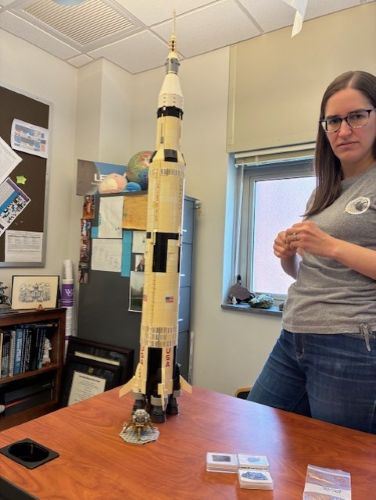
For WCU geology professor Amy Fagan the Artemis missions are personal. As a planetary geologist she studies the Moon, planets and asteroids. Her office, also the office of the department head of the Geosciences and Natural Resources Department, is full of rocks and LEGO.
She keeps her lunar meteorites in small translucent boxes and reminds people not to open them. There is also a heavy iron meteorite from an asteroid and LEGO sets of Saturn V, Space shuttle, the international space station, lunar lander in several sizes and many smaller sets. She has the set for Artemis, but is still working on putting it together. For her this mission is personal.
“It was very emotional because you know how much work has gone into it. I know so many people involved with it,” Fagan said, adding that as she watches the images of Artemis she feels very proud of all the people involved in the mission. But her favorite part is the science room back in Houston.
“Because in the science evaluation room, if you look at any of those pictures or you look at any of the videos, there are so many people in that room that are my friends,” she said. “I don’t know the crew, but there are people in that room I have known for 14-plus years.”
In 2022 Fagan was part of Joint EVA Test Team #3 (JETT3) as a dry run for the actual moonwalk for Artemis III.
“I was part of a team that was doing an analog test for the next land mission on the lunar surface,” Fagan said. “What that means is basically we were playing pretend, but as adults.”
But the pretend was a lot more science than a game. They were given tasks and had to determine where to land, where to collect samples, how to guide astronauts to explore part of the Moon that has not been explored before – the South Polar region that has craters deeper than the Grand Canyon. They also designed the science evaluation room that we could see during the mission.
“When you look at the science evaluation room, in Artemis II, when we’ve seen all that footage, especially on the flyby, that design, a lot of that came out of the work that we had done in 2022,” Fagan said.
She is also part of a team that will land a robotic lander on the Moon in 2029 to explore volcanic terrain on the Moon, collecting data for age dating and chemistry on it.
On the question of why it has taken us so long to get back to the Moon she says the answer is complex but ultimately, it’s about funding and politics. Apollo missions stopped in 1972 when the funding was cut and interests went somewhere else. President Donald Trump, during his first administration, brought back the idea of landing humans on the lunar surface with Artemis.
“One of the tricky things about space exploration is that when the president changes, your focus for NASA may also change,” Fagan said.
The push to go back to the Moon is not really a space race in terms of who gets to be there first and get the glory. It’s a space race in terms of technology development.
“There’s interest in going to the Moon from other countries now,” she said. “One of the big components of going with Apollo was national security. Because when Sputnik was launched, we didn’t know that the Soviets had that technology and we didn’t know that they could do that.”
She hopes that this interest in lunar exploration continues and that Artemis IV will get to land on the Moon and explore and do science and maybe we could get to build a permanent mission on the Moon so we could go to Mars. One of the reasons why Artemis will go to the permanently shadowed regions at the poles is because they have discovered remnants of ice in areas that receive little to no sunlight. That could mean potential for producing rocket fuel or maybe a water source for people who would be living there.
With all her fascination with space and lunar exploration Fagan says she is not interested in going to the Moon. She wants to be part of the science evaluation team back on Earth.