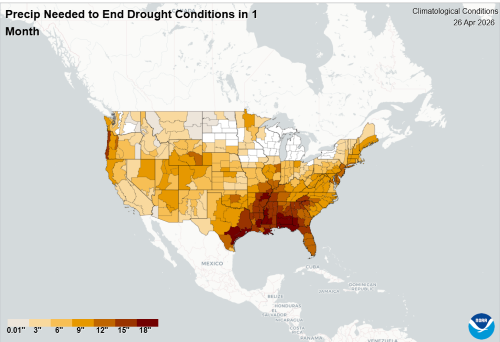
After a prolonged dry season, rain showers alleviate drought conditions in western North Carolina. Although the region is getting scattered rains, it’s not enough to get the region out of the drought. The National Centers for Environmental Information gives a current drought reduction estimate of the amount of rainfall needed to end drought conditions in the span of a month. Around 12″ to 15″ inches of consistent rain is needed to remedy drought conditions in the area.
Currently, rain showers are expected in the region, but the statewide burn ban remains in effect. The National Weather Service predicted rainfall in Cullowhee through the end of April, with less than a tenth of an inch expected, and scattered rain is expected leading into early May. The fire danger prediction in western North Carolina has now been reduced to moderate to low conditions due to the increase in rain as of April 29.
95.3 WWCU spoke with Daniel Manring, the executive director of the Tuckaseigee Water and Sewer Authority. Manring explains what services are provided by TWSA and why the reduced water advisory was sent out on April 24.
“The deficit that we’re in for this time of year is not going to change with a few rain events. So it’s very critical that residents in North Carolina as a whole, or the Southeast… could have a takeaway, I just want them to be water conscious,” Manring said.
Listen to the whole interview here:
The Tuckaseigee Water and Sewer Authority has released a reduced water advisory on Facebook for residents in an effort to conserve water until stream water levels increase in Jackson County.
Residents can help save water by making small changes in their home water consumption:
- Take shorter showers
- Wash clothes and dishwashers only with full loads
- Avoid watering lawns in excess
- Fix any leaking pipes or faucets
According to the N.C. Department of Agriculture and Consumer Services, there is still a statewide ban on open burning since March 28. The burn ban cancels all valid burning permits until further notice in all 100 counties in North Carolina. The violation of the ban is a $100 fine in addition to $183 court costs, according to the NC Department of Agriculture.
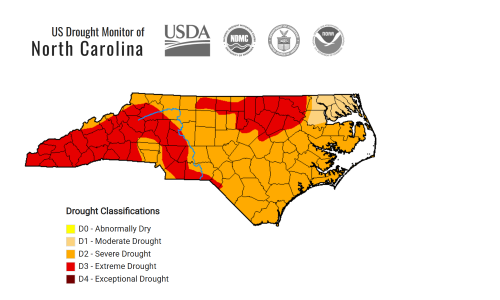
As of April 26 all of western North Carolina is experiencing drought conditions ranging from moderately dry to extremely dry. According to the North Carolina Drought Management Advisory Council, much of the western region is facing severe or extreme drought conditions
95.3 WWCU spoke with Philip Jackson, public information officer for the N.C. Forest Service, in early March about the wildfire conditions in western North Carolina, preventative measures residents can take to minimize fires, and what causes wildfires in the region.
According to Jackson, the deficit in rainfall throughout the region and the remnants of hurricane Helene, wildfires have been able to spread more easily.
“Any ignition source, if it gets inundated in these areas where there’s heavy storm debris, heavy blowdown from damaged timber as a result of hurricane Allen. Those fires are going to burn hotter, they’re going to get bigger, and they’re going to spread quicker, and we’re also going to have a difficult time getting through them,” Jackson said.
Listen to the 95.3 WWCU public affairs program:
Visit the National Integrated Drought Information System, or NIDIS, for more information on drought conditions.