Story co-written with Becki Veach
Have you ever been called by a supposedly trusted source like a bank or a courthouse and the conversation just doesn’t feel right? For example, they try to pressure you into sending money or ask personal questions like your address or credit card information. Well, you’re not alone because you were just scammed.
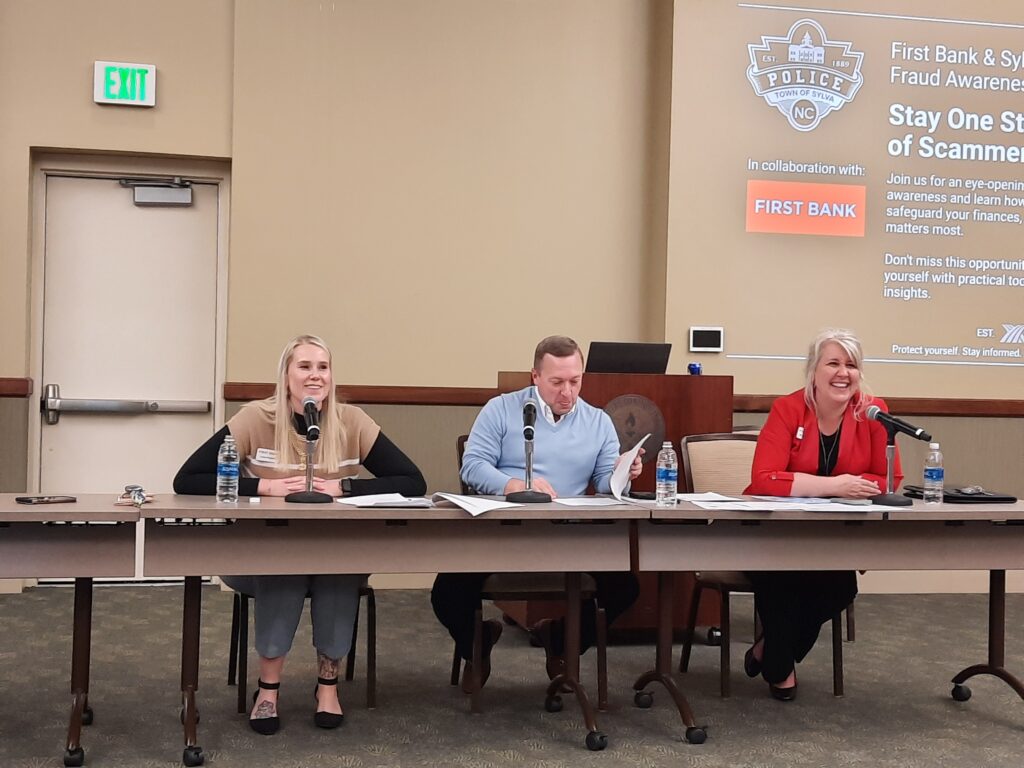
Organizations and businesses like First Bank and Sylva PD are working on combating this kind of fraud. The “Stay One Step Ahead of Scammers!” seminar was designed to help educate the citizens of Jackson County on how to recognize scams, advancements in online scamming with AI assistance, and how to safeguard their finances. Local businesses and organizations included Sylva Assistant Chief of Police, Robbie Carter, First Bank of Sylva Branch Manager, Lexie Franklin and Meka Woodring, First Bank’s Area Retail Manager and Vice President.
Romance scams – more popular than you might think
The panel covered many well-known types of scams and fraud. A romance scam is one of the most popular among them. According to the FTC, romance scams are the fastest-growing fraud category globally, with U.S. losses exceeding $1.3 billion annually.
Scammers create a fake internet persona on dating sites and social media like Instagram, Facebook, TikTok, or use video chat to create a romantic relationship and build trust. Scammers then make up a story and ask for money. Advancements in AI voice and face models have made romance scams visually more real, and people get tricked more easily.
First Bank Sylva Branch Manager Lexie Franklin commented on advanced romance scams that have affected First Bank customers.
“I get a lot of romance scams, actually in my branch. I don’t specifically know why, but it seems like the Sylva branch specifically gets a lot of romance scams. And it’s super hard to talk to somebody when their heart is involved. But if you ever run into an issue where you’re questioning if the person you’re speaking to is a scammer, if you ever have that little bit of skepticism, I would just say, you don’t even have to be a customer. Just come see me. We’ll talk it out,” Franklin said.
The Consumer Sentinel Data Book groups romance scams in the larger classification of imposter scams. When romance scammers have convinced victims to send them money, the financial consequences can be devastating. In 2025, North Carolina reported that people lost around $34 million in romance scams. Since a staggering number of victims of romance scams do not report the fraud, that number is likely much larger, according to FBI reports.
Fake checks & identity thefts
Fake check scams occur when scammers forge a check, send it to a person, and have that person deposit it, often allowing them to”keep” a portion of the money. In reality, this fraudulent check will, more often than not, be detected by the bank in question. That bank will then contact the victim of the scam, telling them to pay the money back. Meanwhile, the scammer enjoys the profits without assuming any of the risk. Americans reportedly lost $23 billion in 2023 due to check fraud.
In 2025, fake check scams were comparatively lower than 2024 or 2023 with 389 scams reporting $2,058,000 lost, according to Fraud Reports by the Federal Trade Commission. To put that into perspective, there were 411 fake check scams in North Carolina in 2024, with more than $2,232,000 lost.
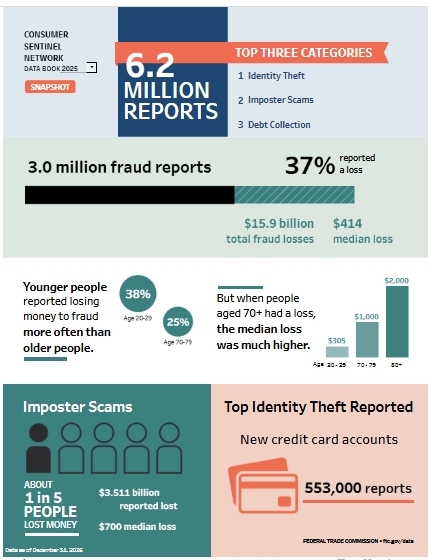
There were around 1.4 million reports of identity theft during 2025, giving it 22% of the total reported fraud cases in the United States. Credit card fraud was one of the top types of identity theft, with 553,000 reports of this type of fraud.
Chief Information Security and Privacy Officer for the WCU IT Department, Matthew Martin commented on the different methods scammers use for identity theft.
“There are lots of different ways scammers can obtain your financial information, and most of those methods have a buffer in between. Card skimmers, for example, collect credit card data from the card’s magnetic strips, which scammers use to make duplicate cards. They can install skimmers on ATMs, gas pumps, and other publicly available card readers by working with other parties and sharing in the profits,” Martin said.
In North Carolina in 2025, there were 2,354 malware and computer exploit scams reported with more than $3,9 million lost to this type of scams.
Debt collection scams and fake court summons scams- rarer but still on the rise
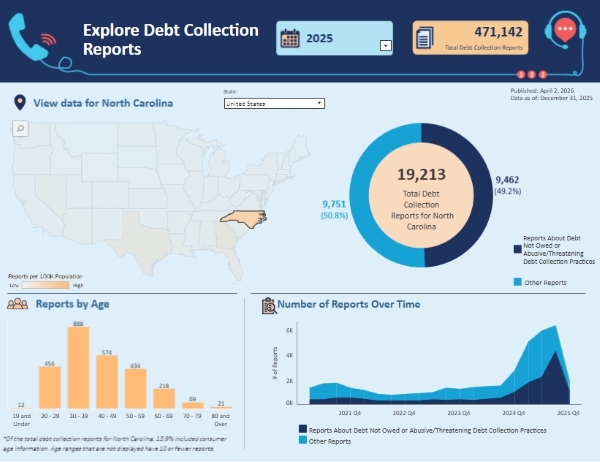
In 2025, there were 471,142 false debt collection reports filed in the United States, with 47.2% of the reports about debt not owed or abusive/threatening debt collection practices, and 52.8% of the cases were about other types of debt collection fraud. In North Carolina, there were 181.5 reports for every 100,000 people in the state.
Fake court summons scams are becoming increasingly common as scammers become cleverer with public courthouse records and advanced online document forging. The scammers impersonate court officials, saying that the victim has either missed jury duty or a court date. The scammer will then threaten to put a warrant out for the victim’s arrest if they’re not paid a certain amount for not appearing the first time.
“The most popular one, I think, at the moment for that is going to sound something like, ‘I am officer so-and-so, a caller from whatever agency, police department, Jackson County Sheriff’s Office. You didn’t go to court on this day,’ or… jury duty seems to be a current one,” Robbie Carter, the Sylva Assistant Chief of Police said.
Recently, scammers have gotten more creative, finding the names of citizens in a certain area so they can say the specific courthouse where they missed the summons. In reality, court officials would never ask for money, especially over the phone.
How companies safeguard against scammers
North Carolina and the Federal Trade Commission collect data on many types of scams and fraud. The database is updated quarterly for consumers and law enforcement personnel to refer to when closing cases.
Franklin specified the kind of security measures that the First Bank takes to combat fraud, especially fraud bolstered by AI.
“When we get phone calls, of course we ask our standardized questions like last four digits of the social security number and comparing the phone number with the account we have on file. But if we know the customer, which 9 times out of 10 we do, we ask them how they’re doing and personal questions that we have previous knowledge of to confirm their identity,” Franklin explains.

Also, in the event of a new kind of scam, First Bank at least once a quarter trains employees on identifiable indicators for different kinds of scams, with the bank usually doing over 100-150 modules for fraud detection training every year. For example, AI voice models created with applications like Otter.ai and Revoicer are now able to perfectly replicate even the tone and cadence of someone’s voice. Because of that, bank employees, if they feel something is off, can often ask personal or routine questions unique to the individual experiences of the customer. Ironically, it’s not just good bank security but good customer service as well that can be the deciding factor in protecting the finances of clients.
Carter also highlighted how both state and federal law enforcement have limited resources in catching online scammers, especially after the scam has already been completed.
Carter explained that the truth is local police departments simply don’t have the resources for local and especially statewide investigations into online scammers. The FBI, even though they have the resources for it, won’t care if the amount of money lost is negligible, like three or four thousand dollars. In 22 years of policing, Carter has only successfully arrested one local online scammer.
Online scams and fraud are inherently remote, so it takes above-average resources to trace back IP addresses, phone numbers, fake identities, etc. However, there are ways to get help.
Resources in the event of successful scam
IC3 is an internet crime complaint center created by the FBI in collaboration with the National White Collar Crime Center for individuals to report different kinds of internet-facilitated criminal activity and fraudulent activities. The system then analyzes the complaint and refers the individual to the appropriate law enforcement agency. To be clear, IC3 itself doesn’t conduct criminal investigations, but it identifies trends and links similar cases to support ongoing criminal investigations by federal agencies (mostly the FBI). Start by filing a report on the IC3 website about the kind of online scam or fraud you’ve experienced. While IC3 cannot guarantee a response to every complaint, the report does help the broader research being conducted to combat online scams and fraud. The website also has other valuable resources you can use to report on and even combat cybercrime.
Martin made a point that avoiding scams like fake court summons, fake job postings, and application fee scams is much simpler than the public believes.
“You have no obligation to talk to these people. 99% of scams can be avoided just by thinking before you act. Scammers pray on pressure and split-second decisions. Remember that you owe these people nothing,” Martin said.
Martin also highlighted how AI and machine learning resources available to the public are also available to scam agencies, making signs of scams that people like Martin could spot virtually non-existent with the new advancements in AI. For example, poor spelling and poor grammar used to be among the most obvious signs of a fraudulent email or text. But AI is able to edit these fake messages and documents to look professional and virtually identical to real documents. Modern technology has also made the quantity of scams next to immeasurable.
“Back in the day, scammers only had so much time to send however many emails to a certain number of people. But now they can send the same fraudulent message to 10,000 people in four seconds. The industry has grown alongside the growth of technology, making it impossible to target a few fraudulent emails when there are now thousands being sent to tens of thousands of people,” Martin said.
So next time someone calls you on the phone and says you need to urgently pay a fine or receive a gift, don’t get upset or excited. Stop the call and think about it, or check it out. If it is too good to be true, it probably is.
Here more details on the scamming and fraud in this episode of Whee Life.