A version of this was published in The Sylva Herald
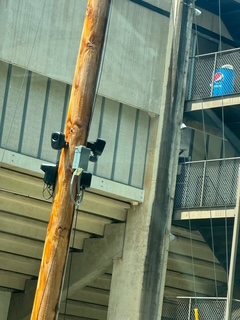
Jackson County has used Flock cameras since 2024, but the technology has faced growing scrutiny nationwide over concerns about accuracy, misuse and privacy.
In Charlotte, accuracy concerns surrounding Automated License Plate Reader systems were highlighted by the wrongful detention of teacher Jasmine Horne in 2021. Charlotte-Mecklenburg Police Department officers entered information connected to Horne and her vehicle into the departments ALPR system while investigating a suspect with a similar name, Jaeslyn Horne.
Officers stopped Jasmine Horne, drew their weapons, handcuffed her and put her in the back of their car, before realizing she was not the suspect they were looking for. Horne later said this experience caused her to develop PTSD.
Another instance occurred in York County, S.C. in 2024, when a Flock camera mistakenly flagged Steven Melvin’s car as stolen. A sheriff’s deputy drew his gun on Melvin and ordered him to kneel with his hands over his head for more than five minutes.
The Flock camera had misread a single character of Melvin’s plate, mistaking it for the stolen vehicle. The York County Sheriff’s Office blamed the misread for a tinted tag cover, but the same cameras had accurately read Melvin’s plate 13 times that month prior, according to the lawsuit Melvin filed.
A 2021 study by IPVM, a security and surveillance industry research group that focuses on reviewing and reporting on video-surveillance technology, found the ALPRs misread the state on one in 10 license plates.
To implement the Flock system, users must provide a reason for the lookup. Reports from the American Civil Liberties Union show that many times these reasons are vague and cast a wide-net, using terms like “investigation” or “crime.”
On top of concerns about accuracy with the cameras, another rising worry is how agencies prevent misuse and monitor access to the data stored within ALPRs
Data sets obtained by the Electronic Frontier Foundation showed hundreds of ALPR searches related to political demonstrations between December 2024 and October 2025. Some searches explicitly referenced protest activity, including 50501 in February, Hands off in April and No Kings in June and October, while others used vague terminology.
Critics have also raised concerns about officers misusing ALPR systems.
There have been 73 documented incidents of ALPR misuse from 2019 – 2026, according to the ALPR Abuse Library, an online database that tracks reports of abuse, misuse and civil liberties concerns related to ALPRs and with a focus on Flock.
The Institute for Justice, a nonprofit law firm, found that law enforcement officers have used ALPRs to stalk romantic interests at least 30 times since 2021, with most cases occurring after 2024.
Both the Institute for Justice and 404 Media say these cases are likely vastly underreported since they primarily include cases in which the behavior led to officers being fired, arrested or both.
In Charlotte, CMPD Officer Seth Elliott was arrested July 29 for improperly accessing the Flock system. The State Bureau of Investigation discovered the access during an unrelated investigation.
In Richmond County, Ga., former Deputy Jaquarius Yarbrough was arrested after allegedly using the Flock system to search the license plate of a woman he’d been having an affair with 1,639 times over several months.
The behavior was discovered during a routine audit of the Richmond County Sheriff’s Office Flock ALPR system.
In Wisconsin, a woman checked her own license plate on the website HaveIBeenFlocked.com and found that Milwaukee Police Officer Josue Ayala had searched it over 100 times. After she reported this to the police, the department conducted an audit and found Ayala had also searched the license plate of someone else 124 times, both between March 26 and May 26, 2025. For each search, Ayala listed “investigation” as the reason for it.
Beyond issues of misuse and accuracy, critics have also raised questions about privacy concerns.
In July, 404 Media received documents showing that law enforcement agencies across the country have input searches for specific people, not just cars, into the Flock system. Departments use Flock’s FreeForm feature, which allows officers to use Flock as a search engine while the AI and image recognition interpret what is relevant to that search.
This feature is primarily advertised as a feature for Flock’s Condor video cameras which include other capabilities including automatically detecting, zooming in on and capturing high resolution images of people and vehicles, according to Flock’s website.
From the data received by 404 Media some of the FreeForm searches include “backpack” “person walking” or “black sweatshirt” from Dunwoody, Georgia’s Police Department. The California Highway Patrol searched “gray shirt” across 247 cameras, while the Brookhaven, Georgia Police Department searched for “tall man.”
“AI-enabled video analysis across reams of footage exacerbates the risk that law-abiding people minding their own business end up with police observing them without their knowledge and opens them to possibly being implicated in a crime or being treated as a criminal,” Beryl Lipton, senior investigative researcher at the EFF, told 404 Media.
As of Aug. 7, DeFlock reported that 100 cities have rejected license plate readers. This includes canceling or rejecting contracts, deactivating cameras or outright banning ALPRs like Ypsilanti, Mich. did.