If you’ve had a WCU commuter parking pass and parked in the parking deck, you have likely seen butterfly wings throughout the stairwells.
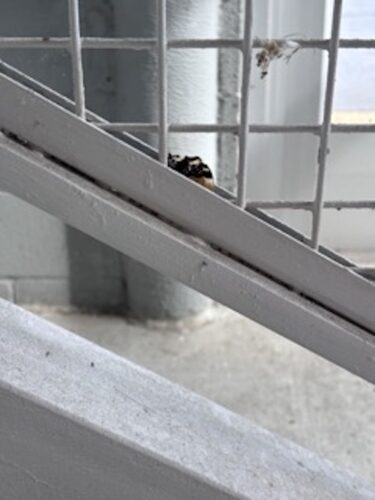
In case you have never walked through the parking deck, the wings I am referring to are mainly from the North Carolina state butterfly: the Eastern tiger swallowtail. You’ve likely seen them flying throughout North Carolina (or any part of Eastern U.S.).
Remnants of wings cluster throughout the stairs, leaving feelings of confusion that we have all likely encountered when a bug comes into a manmade space: if you found your way in, how come you cannot find your way out?
Like all insects, butterflies are cold blooded, relying on thermoregulation to fly. Due to their biology, butterflies rely on behavioral instincts to find warm environments. Whether that be a riverbank or a body of concrete, there is no behavioral distinction when it comes to survival and modern evolutionary adaptations. With modern infrastructure and human’s overwhelming impact on the environment, they have chosen manmade environments without a full grasp on the repercussions.
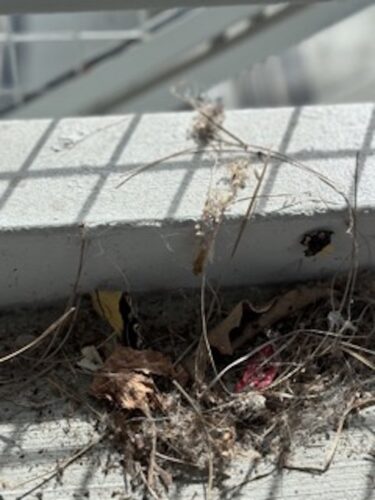
After surveying the parking deck, I noticed that the wings were less notable than last year when I had a commuter pass. After taking some more time to closely observe, I noticed that fragments of wings appeared to be swept to the side alongside dry grass and leaves. Nearly a dozen decomposing wings lined up on the stair perimeter—a few others were scattered amongst the other stairwells. Interestingly enough, as I walked out of the deck two butterflies flew onto my leg.
Wanting to find out more, I drove out to Canton, North Carolina to The Ten Acre Garden to see Dr. Harvey Joanning discuss butterflies during the farms Dahlia Festival. Joanning’s specializes in neuropsychology, with a teaching background at Iowa State University and the University of South Alabama, and is a citizen science volunteer with the Carolinas Butterfly Monitoring Program. The program is partnered with the Great Smokey Mountains National Park.
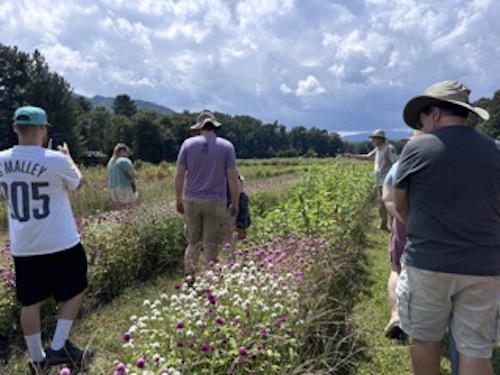
After walking through rows of flowers with Joanning and the two dozen who joined to hear him speak, we sat down and he explained why there are so many dead butterflies in the WCU parking deck.
“What’s happening is that they’re attracted to the heat, especially as they’re starting to feel fragile. As they end their lifecycle…like anybody else that’s not feeling good they’re going to go to a comfortable spot…By the time they’re getting in there, they’ve done their duty–they’ve reproduced. You know, I’m a neuropsychologist; our brain is designed to keep us alive long enough so we can reproduce. Butterflies are the same.”
Below is an extended conversation with Joanning.
Joanning recommended that I speak with his associate and butterfly expert Dr. Jeff Pippen. Pippen is the director of the Carolinas Butterfly Monitoring Program, and co-director of the North American Butterfly Monitoring Program as a research specialist in the Riles Lab of Butterfly Informatics at Georgetown University.
Pippen has the answer to my question – why can’t they get out the same way they got in? After talking and showing the deck’s glass infrastructure to him, the answer was ‘light.’
“I suspect they ‘accidentally’ fly into the stairwell thinking they can just fly through; but they run into a window and don’t know how to get out. They just know how to fly to the light,” explained Pippen.
Associated with transformation and freedom, the metaphorical lifecycle of butterflies draws us to them. As for the butterflies, they are drawn to the warmth and light provided by the parking deck. Unfortunately for these ephemerals, their lifecycle ends with being drawn to concrete.