Western Carolina University’s freshman class is settling into campus life one month at a time to make Cullowhee feel like home.

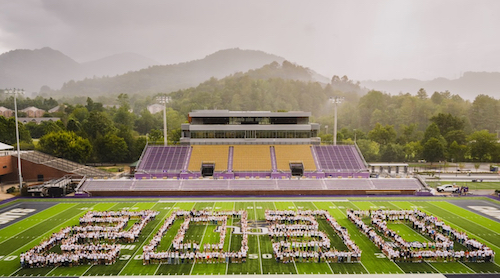
WCU’s Class of 2030 is the largest freshman class in history. Chancellor Kelli R. Brown reported 2,385 freshmen this fall, contributing to an overall enrollment of 12,308 students.
While some students have noticed changes around campus, the first month has also given freshmen opportunities to find their place at WCU.
Assistant Director of Campus Programs Corbin Huntley said this year’s Week of Welcome events brought hundreds of students to campus throughout the week.
The Catafount Takeover and Drone Show on Aug. 18 had the highest attendance, with 1,010 students. The Food Truck Coupons and T-Shirt Giveaway drew 823 students, while Adopt-A-Plushie brought in 775.
Other events, including tie-dye on the lawn, canvas painting and dorm decor, also brought hundreds of students.
For freshmen, campus events can be an opportunity to meet people outside of the classroom and become more comfortable in a new environment.
Leon Shay, a political science freshman, said his first month at WCU has gone well.
“It’s been really nice coming in,” Shay said. “I love my classes; I love my professors. The food’s ten times better than I’m used to. It’s very nice to be on campus.”
Shay also mentioned that classes have been helpful in his experience.
“It’s definitely a new experience and it’s good, because it’s helping you learn about the real world and the adult situations that go on, and it helps you develop more knowledge in what you’re kind of studying in the future,” Shay said.
Freshmen roommates CJ Roux and George Gonzalez have also found the transition to college to be a smooth one so far.
“Settling in has been pretty easy,” Gonzalez said. “The area in general is like a very nice, calm area. There’s not anything stupidly crazy happening, but it’s also just nice in general.”
“The people here are really nice,” Roux said. “I feel like it’s been pretty easy.”
Their experiences reflect one part of the adjustment process, but not every student will settle into college at the same pace.
Research from U.S. News outlines eleven steps that can help freshmen prepare for the transition to college. The recommendations include developing time-management skills, paying attention to university communications, building relationships with professors and peers, getting involved on campus and knowing where to find academic support.
The research also emphasizes that adjusting to college takes time as students become accustomed to different academic expectations and independence.
Meghan Gangel, WCU psychology professor, provided insight into the developmental side of that transition from high school to college.
“Our brain is still changing, our body is still changing, and then, what does that mean for us psychologically in terms of our behaviors, our emotions, our cognitions?” Gangel said. “Well, that’s all changing, too, right? And so, it’s a real big period of transition that is still occurring.”
Gangel also mentioned the challenges of being away from home for the first time and the impact homesickness has on students’ psychological wellbeing.
“Change is hard. Change is scary, right? You’re away from those systems that you are just really used to. And so, we would be psychologically craving that,” Gangel said. “We shift into this new environment, and we might feel isolated. We might go, ‘I just don’t know who I can connect with, who is safe yet, who is like me.’ And so that’s really, really hard.”
Gangel discussed the importance of social connections as freshman adjust to campus.
“When we move to college and we lose our original support systems, we need to gain new ones,” Gangel said. “They [connections] are not an added bonus. They are an actual necessity for us to do well. Otherwise, we’re not going to thrive in those systems.”
For students who are struggling with the adjustment, Residential Case Manager Brian Boyer discussed the importance of giving themselves time.
“I think you just have to give yourself time, stay the course a little bit, try to get involved in something,” Boyer said. “Get out of your room, you know, try something you wouldn’t normally try, push yourself a little bit.”
Boyer also gave advice on finding a balance between academics, social life and other responsibilities.
“I think ultimately it comes down to knowing your priorities and making sure that you have the ability to set boundaries for yourself,” Boyer said. “A social experience is important, but you can’t have that if you’re not enrolled, and you’re not going to be enrolled if you don’t make the grades. So, you just have to remember ultimately what is most important.”
Boyer said the most effective way to adjust to college is to be patient with yourself and to give yourself grace.
“Be honest about what you’re feeling and seek out the resources that you need and just, again, give it some time,” Boyer said. “All this stuff just takes a little bit of time, a little bit of patience, a little bit of grace, and ultimately, it will hopefully get better.”
A few campus resources for freshman include the Writing and Learning Commons, Counseling and Psychological Services, and BetterMynd.
For those still searching for ways to get involved, check out the WCU ENGAGE website to view a catalogue of campus events hosted by a wide variety of clubs and organizations.
For the Class of 2030, the first month is only the beginning. As students continue through their first semester, they will have more opportunities to build friendships, get involved, develop routines and find the people and resources that help WCU feel like home.
Related content: Listen to the Whee Life Podcast episode on the Class of 2030 for more.