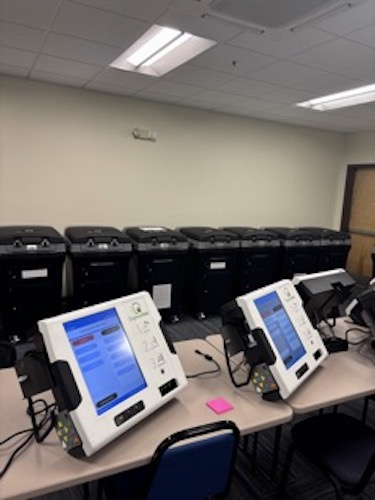
Machines and all sorts of equipment lined the large room at the Jackson County Board of Elections at the end of September and the staff was busy checking them as the BOE prepares for the 2026 election. The room currently shies away from people aside from employees, but come Oct. 15, voters will come to cast their votes using the machines and many poll workers will be helping them cast the vote.
The BOE hosted a public Logic and Accuracy Testing Sept. 28 and Sept. 29, displaying how voting machines are tested, and how difficult it is to steal elections with voting machines.
Political rhetoric has been circulating throughout the years—and most recently with news reports highlighting statements from President Trump and his Department of Justice, claiming voting machines and mail-in absentee ballots risk compromise and can result in rigged elections.
To counteract any speculations, the Board of Elections welcomed voters to learn more about the machines, explaining an in-depth process of steps and systems established to protect elections.
As a registered voter myself, I went to the BOE to walk through this process with employees Kylee Muench and Daniel Landa. It was first disclosed how each testing includes a pair of individuals with two differing voting parties to retain neutrality.
The testing process is done before each election cycle starts, with each Express Vote machine, also named the Big Pencil, and DS-200 Tabulator. The testing is meticulously, and there’s a widespread history throughout North Carolina when it comes to election security as Director Amanda Allen explained.
“This is something that is standardized across the state, so every single county has to do logic and accuracy testing every single time. So really, this is a big undertaking, but for example, in a primary, if we had a primary in March, we would do logic and accuracy testing. If they immediately call for a second primary, we would do logic and accuracy testing again. So, it is something that is required and pretty routinized. Every county gets to pick from a limited pool of acceptable equipment. So we might have different types of equipment, but they [State Board of Elections] give us guidelines and provide us a list and everything, so it is pretty standard.”
Each DS-200 or the Tabulator is assigned to a specific precinct. The DS-200 is owned by ES&S, which is a verified vendor. Any company who wants to sell voting equipment in North Carolina must go through a vigorous application process and presentation process with North Carolina to be considered for elections.
Landa explained how these machines are tested.
“In here, we have at least the 13 [DS-200] for each precinct, and then we have the five for every early voting site, and then we have another five that we dub administrative ones. So those are the ones that accept things like our provisional ballots or absentee ballots or transfer ballots and stuff like that,” Landa said. He pointed then to the Express Vote machines and added. “Then we also have around 50 or so of these machines that go to every site as well. And these are just our ballot marking machines. This is where you physically choose each option when you’re voting. This doesn’t hold any data as to what people have voted…this is just what we dub the ‘big pencil’.”
At no point are these machines connected to the internet.
Preliminary steps are enforced throughout mock elections and are aided with test ballots, keys, USB drives, passwords, transcripts (receipts), and tagged seals. Listed below are the steps taken while testing ballots.
A set of test ballots are sent to be scanned through the DS-200. The test deck is pre-marked with a key, so the BOE can check and determine that each ballot matches up with accurate counts. A checklist assigned from the state is followed for every machine.
The DS-200 looks like a big trash can containing three separate bins (boxes) – so three separate keys to open each bin. Each ballot bin (including the emergency bin) is checked and confirmed clear of any ballots. After the bins are checked, they are instantly locked back up. Next, the power cord is checked for connection and the tabulator is turned on to begin the boot up process. This upper compartment of the machine is also secured by a separate key. After being unlocked, the USB election media is installed for the poll. This holds the current election data to prime the machine with the correct data, triggering the machine to print a configuration report, so employees can verify that the correct precinct and election matches. Next, the machine is qualified, and when the polls open, the zero tape will print, confirm all those zeros again, and leave the tape connected to the machine. Once the dates match (in this instance Nov. 3) the process is complete, and a password is inserted so qualification media can be removed to make way for the next media USB.
In this case, the specific mock election is assigned to “Greens Creek Election Day”. Now the specific site election data is ready to be tested on the DS-200. Again, passwords are entered, dates are checked, and the configuration report runs, polls are opened, and the zero tape prints. Once all the zero’s are listed, Muench and Landa write their names on the tape as confirmation.
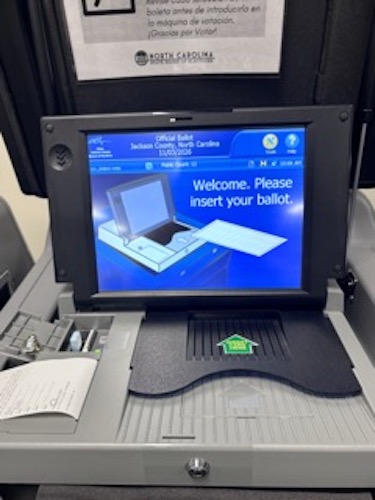
The voting mode now starts for the test decks to be tested, ensuring that two cannot be read at a time, or bubbling errors are caught. When these errors are caught. If you undervote, the DS-200 asks if the voter if that was their intent. If multiple go try to go through the system, the machine beeps, alerting all poll workers to check out the situation. Once different types of voting scenarios are checked, the poll can be closed, and the results are printed and verified. Finally, everything is shut down, the USB media stick is removed in conjunction with the logic and accuracy testing as Landa explains,
“We pull the media stick because in conjunction with our logic and accuracy testing, this is also part of what we call our mock election–it’s something all 100 counties in North Carolina do. We’ll run our test decks and then we’ll take the data that are on those sticks and we’ll input them and upload them to the state [SBE] as if we were running a real election.” explains Landa. “Once we’ve done all of them, we will upload every single one…and then once that process is done, the mock election is complete. We come back in here and then we wipe all the data off of here, so they’re back to zero and there’s absolutely no votes on this memory stick. And we’ll reset the device, and then that is when we lock it up. We’ll add 3 seals to every single location. We annotate those seals and those annotated seals go to the judges on election day. When they go to open up, they’re verifying that those are still the exact same seals that we put on there so they know no one else has touched this machine since the logic and accuracy testing.”
Finally, everything is locked up and the tape is stored during the retention process. Any information deemed sensitive is stored in the house (BOE), never owned by outside parties.
Witnessing this process myself showed just how precautionary and detailed elections are; there was no room for fallacy nor fraud. But not everyone has the opportunity to view processes like this, allowing confusion and conspiracy to circuit around, as Allen explains,
“The amount of people who work in elections is very small. So if you’re just going off of what you see, you may have a lot of questions. You may not understand what the equipment is capable of, what’s in there, what are the risks. And so a lot of things in our public discourse there’s a lot of opportunity for disinformation and for sharing things that might not be true… Everyone wants elections to be super secure. They want to know that their vote matters and that it’s being taken care of. But when you don’t know what goes on behind the scenes, there is an opportunity to be confused or to be worried. That’s why logic and accuracy testing is a public meeting. We want people to come see this,” Allen said.
For more information on election safety, visit JCBOE election security page.
Some important dates to remember:
– Voter Registration Deadline is Oct. 9
– Early Voting (and same day registration) starts Oct. 15 through Oct. 31. Jackson County has 5 polling locations:
Two in Cullowhee: Cullowhee Rec Center (88 Cullowhee Mtn. Rd.) and WCU Health & Human Sciences Building (4121 Little Savannah Rd., Cullowhee). In Sylva Skyland Service Center (876 Skyland Dr.-Suite 1). In Cashiers the polling site is at the Cashiers Rec Center (355 Frank Allen Rd); and Qualla Community Building in Witthier (181 Shoal Creek Church Loop Rd).
– The deadline to request Absentee Ballot is Oct. 20
– Absentee Ballots must arrive to the board of elections in the county you are registered by the closing of pools on Election Day, Nov. 3
– Election Day is Nov. 3 and you can vote only in your precinct. Jackson county has 13 precincts on Election Day. Cullowhee voters will go in the new Election day site at the HHS Building on Little Savannah Rd.