What happens when a ballot feels like too much?
For Jackson County voters, the November midterm election will bring a long list of races and candidates to choose from.
A ballot with more choices means more decisions for voters to make. For some voters, seeing a long list of races and candidates may feel overwhelming.
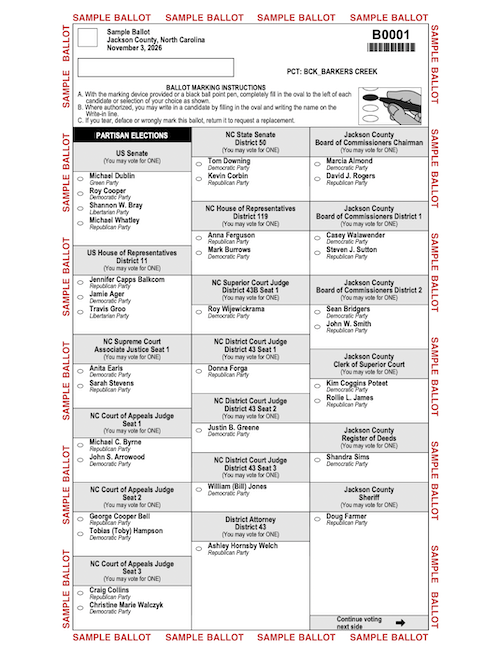
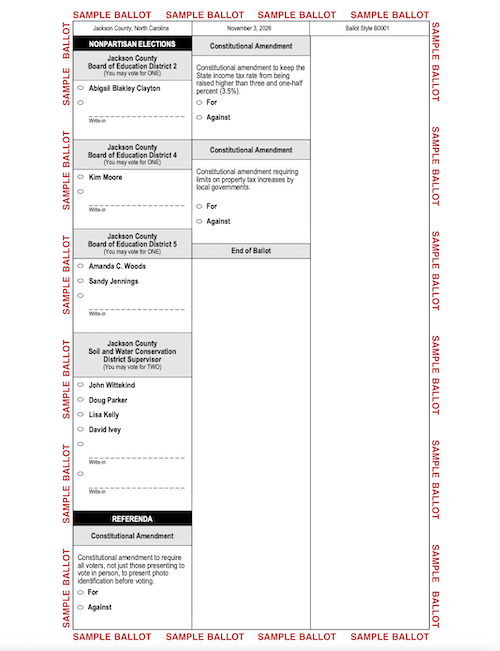
Jackson County will have over 20 office contests and three state constitutional amendments for voters to choose from.
Voters may also reach a race on the ballot where they do not recognize any of the names or know what they are voting for. When voters come across a candidate or race they do not know, election officials encourage them to prepare before going to the polls.
One way to prepare is to look at the sample ballot before going to the polls.
Jackson County Board of Elections Director Amanda Allen said voters can find their sample ballot through the voter search tool on the North Carolina State Board of Elections website. She recommends voters view the ballot before election day so they know what to expect.
“Every time we have someone come into our office to pick up a sample ballot, they gasp when they realize it’s printed on two sides,” said Allen. “I would much rather they have that surprise and that shock when they’re looking at a sample ballot than when they are standing there, going through, actually marking a ballot.”
For voters who reach a race and do not recognize the candidates, Allen said they do not have to make a selection.
“If you don’t feel confident picking a person, you can skip,” said Allen. “If you just don’t want to pick that person, if you don’t feel like you want to vote in that contest, you can do that as well.”
Allen said they see less voter participation as they go down the ballot to the local candidates.
“You will see people get tired,” said Allen. “I can see the first contest is going to have the highest amount of people who responded and it’s going to get lower and lower and lower.”
Allen also encourages voters to carefully review their ballots before leaving the polls.
“We really don’t want you to get tired before you get down there, but with our ballot marking devices, once you’ve made your selections, you have a chance to review and you can make changes, but also when your ballot comes out, look at it, read it,” said Allen. “We do provide a ballot that you can see what you chose, and if you need to make corrections, let someone know in the polls.”
The research behind it
What happens when voters reach the end of the ballot and have to choose between races they know little about?
Research suggests that the number of choices on a ballot can affect how voters make decisions later in the ballot.
The Review of Economic Studies found that voters who had to make more choices before reaching a race were more likely to skip it or use a shortcut to make their decision. Researchers called this “choice fatigue,” which means that making many choices can make later decisions harder.
Voter fatigue stems from the psychological phenomenon of “decision fatigue,” which is the mental exhaustion of dealing with dealing with heavy choices and the declining quality of selection after a long session of decision making.
Other research has shown the connection between longer ballots and ballot roll-off, when voters participate in an election but leave some contests blank.
Not knowing much information about a candidate does not necessarily mean voters will choose at random. Instead, there are other factors that they can use to make low-information decisions about how to vote.
The brain becomes mentally fatigued after consecutively making multiple decisions, so it will attempt to make shortcuts to decrease the workload. Factors that may affect voter decisions are the order of candidates, incumbency, name familiarity, candidate cues such as gender and race, ballot design and party affiliation.
These shortcuts can make it easier for voters to make decisions when they do not know much about a race. However, they can also mean that voters make choices based on information that does not necessarily tell them how a candidate would perform in office.
For voters working through a long ballot, this can create a difference between the races they know the most about and the races they encounter later with less information. This is one reason researchers study ballot order, voter participation and the number of contests voters complete.
How can we deal with voter fatigue?
Voters can prepare for a long ballot before reaching the polls by reviewing a sample ballot and researching candidates and races they know less about.
Allen suggests looking at the ballot ahead of time to help voters understand which races they will encounter and avoid making every decision at once. They can print their own sample ballot, write on it, take notes, and bring it to the polls with them to help them go through the heavy ballot.
“You can bring a sample ballot into the polling place with you, you can have it pre-marked,” said Allen. “It’s really hard to remember all this stuff. But take the time, start looking into this stuff.”
Voters can also look beyond statewide and national races that are easily to feel overwhelmed about. Local contests, including county commissioner and school board races, can affect decisions in their communities but may receive less attention.
“Our ballots are put in order by the level of the contest,” said Allen. “So when we get down to that local stuff, that’s at the end, but that’s the stuff that really impacts your life. Those are the folks that you might have the most opportunity to talk to, get to know before you vote for them.”
At the polls, voters can review their selections before submitting their ballot. Allen encouraged voters to use this opportunity to check their choices and make corrections if needed.
For voters who want to learn more about local races, the Western Carolina Journalist will continue covering Jackson County candidates and issues throughout the midterm election.
Here are a few important dates to keep in mind for this election:
- Oct. 9: Voter registration deadline (5 p.m.).
- Oct. 15: In-person early voting begins; same-day registration available.
- Oct. 31: In-person early voting ends (3 p.m.).
- Nov. 3: Election Day. Absentee ballot return deadline (7:30 p.m.).