The North Carolina Constitution sets out the basic framework within which state government operates. Unlike ordinary legislation, a constitutional provision cannot be altered by a later General Assembly acting alone. A proposed amendment must first win the required approval from the legislature and then be ratified by the voters. So, the General Assembly in 2026 elections listed three constitutional amendments for the voters to decide on.
What is the difference between state and federal constitutions?
State constitutions differ from the federal document in several ways.
First, state constitutions are easier to revise. States replace their constitutions frequently with the states having ratified 145 new constitutions, most of which were drafted by constitutional conventions since 1776. The North Carolina Constitution, ratified in 1971, is the state’s third constitution and consists of 14 articles. Since its adoption, it has undergone 42 amendments.
Second, all state constitutions are longer than the federal Constitution, which is just 7,591 words. To put that into perspective, the North Carolina constitution is approximately 18,000 words long.
Lastly, state constitutions contain broad rights protections.
We thought it is useful to explain why is the NC Constitution and constitutional changes important to go into the three proposed amendments in this elections ballot.
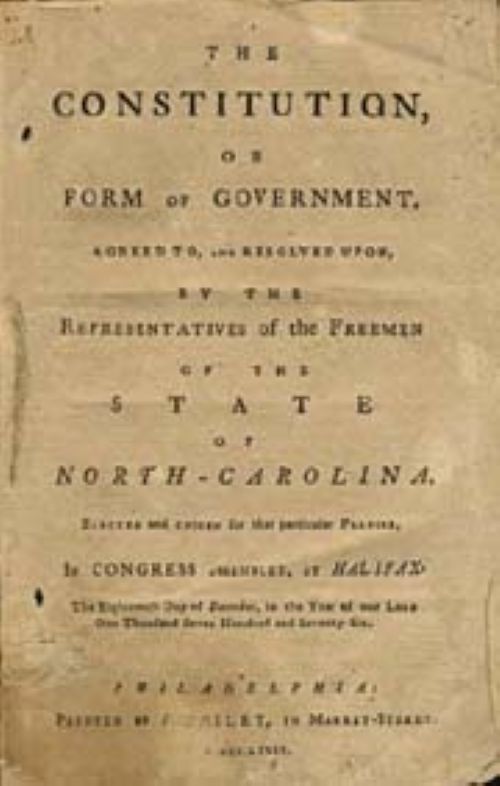
Photo ID for voting (SAVE Act)
How it appears on the ballot: “Constitutional amendment to require all voters, not just those presenting to vote in person, to present photo identification before voting.”
What it will do, if passed: The Safeguard American Voter Eligibility Act or the SAVE Act is federal bill that would require proof of citizenship for voter registration for federal elections, usually by requiring documentary evidence like U.S. passport, birth certificate, real ID, naturalization certificate or certificate of citizenship, etc. This amendment would also alter the language of the current voter ID law to require absentee mail-in ballot voters to present photo identification – as in-person voters do.
Under current federal law, states use a variety of registration systems, including online registration, registration through motor vehicle agencies, automatic voter registration, mail registration, and community-based registration drives. The SAVE Act would disrupt all of these systems and even eliminate some of them depending on separate legislation.
North Carolina already requires voters to show ID, but if this amendment is approved, the requirement would be written into the state constitution. Lawmakers approved the measure in December 2024. Since it passed only a month after a statewide election, it appears on this year’s ballot.
Department Head and Professor of Political Science and Public Affairs at Western Carolina University, Todd Collins, commented on the SAVE Act.
“The SAVE Act would be a federal law requiring more centralized processes,” said Collins. “Presumably, they could change exceptions through other laws, if the SAVE Act were to pass. For North Carolina, the state legislature already has the power to change the voter ID rules based on the current law and would still be able to if the NC constitutional amendment passes.”
State Income Tax
What it will do, if passed: The amendment would lower the North Carolina Constitution’s maximum allowable state income tax rate from 7% to 3.5%. Therefore, the state government would be prohibited from increasing the state income tax rate above 3.5% without voter approval of another constitutional amendment.
Does NC have a precedent for state income tax amendments? In 2018, North Carolina voters approved Session Law 2018‑119, which amended Article V, Section 2 of the state constitution to lower the maximum allowable state income tax rate from 10% to 7%. The amendment was approved by voters with a 57.35%–42.65% margin. That was the first time the North Carolina constitution was changed to set a lower income tax cap.
If approved, the Session Law 2026‑4 (SB 1080) amendment would prohibit the state from raising the income tax rate above 3.5%. Keep in mind that the amendment does not change the current rate immediately, because the rate is already set to 3.49% until January 1st, 2027, under existing NC law.
What are the consequences of passing this amendment on both the state and general population? The state constitution already limits the maximum income tax rate, but this new, even lower income tax cap would lock in tax breaks for corporations. It would also block future lawmakers from fair revenue options when needed.
“Lowering income taxes has been a priority of the current majority party in power in the legislature for many years,” said Collins. “Having a constitutional amendment would make it more difficult to raise it back up.”
Local Property Taxes
How it will appear on the ballot: Requires the General Assembly to enact laws limiting increases in property-tax levies by local governments. The amendment does not establish the limits or formulas; those would be determined through subsequent legislation, which may include exceptions.
What it will do, if passed: This amendment requires the General Assembly to enact laws limiting increases in property-tax levies by local governments. The amendment does not establish the limits or formula; those would be determined through subsequent legislation, which may include exceptions. There is no state property tax in North Carolina. Instead, local governments set property tax rates and collect funds to provide services like waste management, public safety, K-12 school facilities, teacher salary supplements, and recreation. This constitutional amendment would give the state legislature the power to set a limit on the ability of local governments to increase property taxes by creating a levy limit.
What is NC’s current tax rate? North Carolina already has a property tax rate cap of $1.50 per $100 of assessed value, but this limits the rate, not the total revenue. A levy limit would cap the total amount of property tax revenue a local government can raise from one year to the next, regardless of population growth, economic changes, or service needs.
Property taxes are assessed and collected by North Carolina counties and levied as a percentage of a property’s assessed value. According to Ballotpedia, the 2016 county tax rate in Wake County was set at 0.615%, or $615 per $100,000 in assessed value.
As of 2024, North Carolina has an effective tax rate of 0.66%, or about $660 per $100,000 in assessed value. According to the Tax Foundation, North Carolina is ranked #33 highest state in terms of effective property tax rates. Illinois and New Jersey are the highest, at 1.88%, and Hawaii is the lowest at 0.30%.
The amendment was introduced as House Bill 1089 (HB 1089) by state Rep. Brian Echevarria (R-82) on April 28, 2026. In the North Carolina House of Representatives, HB 1089 was approved by a 73-46 vote. In the North Carolina State Senate, HB 1089 was approved by a 31-15 vote. Votes in both chambers were mostly along party lines, with Republicans supporting the amendment and all but one Democrat opposing it.
Who is for it, who is against it, and why:
Supporters for the amendment, mostly republicans, argue that it would slow property tax growth, improve affordability, and protect homeowners from rapid increases.
The League of Women Voters of North Carolina, a non-partisan organization, argues that “restricting local property-tax revenue could affect funding for public education, elections and other local services and/or increase reliance on fees.”
According to the National League of Cities, property tax is a key source of revenue for over 90 % of local governments across the country and makes up about 37 % of total tax revenue across all local governments.
Keep in mind that the average homeowner would save just $84 a year — or $7 a month.
As for corporate property owners, however, they would see noticeable cuts. Data centers are major contributors to real property taxes (land and building) and, in many jurisdictions, have business personal property taxes on servers, storage systems, and cooling equipment, generating millions of property taxes annually. So, in that sense, the average data center would see a $1.2 million annual tax cut.
For example, in Rutherford County the average homeowner would save $54 in property tax payments, while a Meta data center would see their bill cut by $1.2 million.
It’s also worth nothing that, in North Carolina, counties cannot levy income taxes, so property taxes are the primary source of local government revenue for services such as public schools, law enforcement, libraries, water and sewer systems, and other municipal functions. In most NC counties, property taxes account for over half of the General Fund budget, with Jackson County reportedly being one of those counties.
According to the NC Budget and Tax Center, property taxes make up 54% of the General Fund revenue for local services for Jackson County. That’s $57 million.
Jackson County, NC property taxes are due each year on September 1, become delinquent on January 6, and accrue 2% interest in January plus 0.75% monthly thereafter; the county’s current effective tax rate is about 0.38% (median annual bill $976). [ LINK AND SOURCE?]
How would this amendment change property taxes?
First, there is no inherent guarantee of flat bills. Individual tax bills could rise or fall depending on property assessments, tax base changes, and revaluations. Applying that principal to individual homeowners, because every property is different, two homeowners in the same county could see different changes in their tax bill.
Second, proponents say it would curb rapid tax growth; opponents warn it could force cuts to schools, libraries, parks, and emergency services, as seen in other states. In states where property tax limits were put into place recently, local governments have closed community pools, considered deep cuts to emergency services, cut hours and staffing at libraries, and more.