All three proposed constitutional amendments, including the federally initiated SAVE Act or photo ID amendment, were approved by NC voters.
Passing an amendment requires approval from three-fifths of lawmakers and a majority of voters.
These amendments cemented Republican lawmakers’ top priorities ever since taking over the General Assembly in 2011 like overhauling the state’s tax policy and strengthening voter ID laws.
Income Tax Cap Amendment
The income tax cap amendment got a 62% voter approval rating (2,529,381 for vs. 1,556,525 against) among all 100 counties in North Carolina.
The income tax amendment comes from Session Law 2026-4 (Senate Bill 1080), ratified May 21, 2026. It rewrites Article V, Section 2(6) of the North Carolina Constitution so that “the rate of tax on incomes shall not in any case exceed” three and one-half percent, instead of seven percent. The rule is that personal exemptions and deductions must be allowed so that only net income is taxed stays in place.
Federal income tax rates are determined by the U.S. federal government under the Internal Revenue Code, administered by the IRS. These rates apply nationwide and are the same for all taxpayers regardless of state of residence. The federal system uses progressive brackets (currently 10% to 37%) and sets uniform rules for deductions, credits, and taxable income definitions. State income tax rates, on the other hand, are set by each individual state (and in some cases, local governments) within their own legal authority.
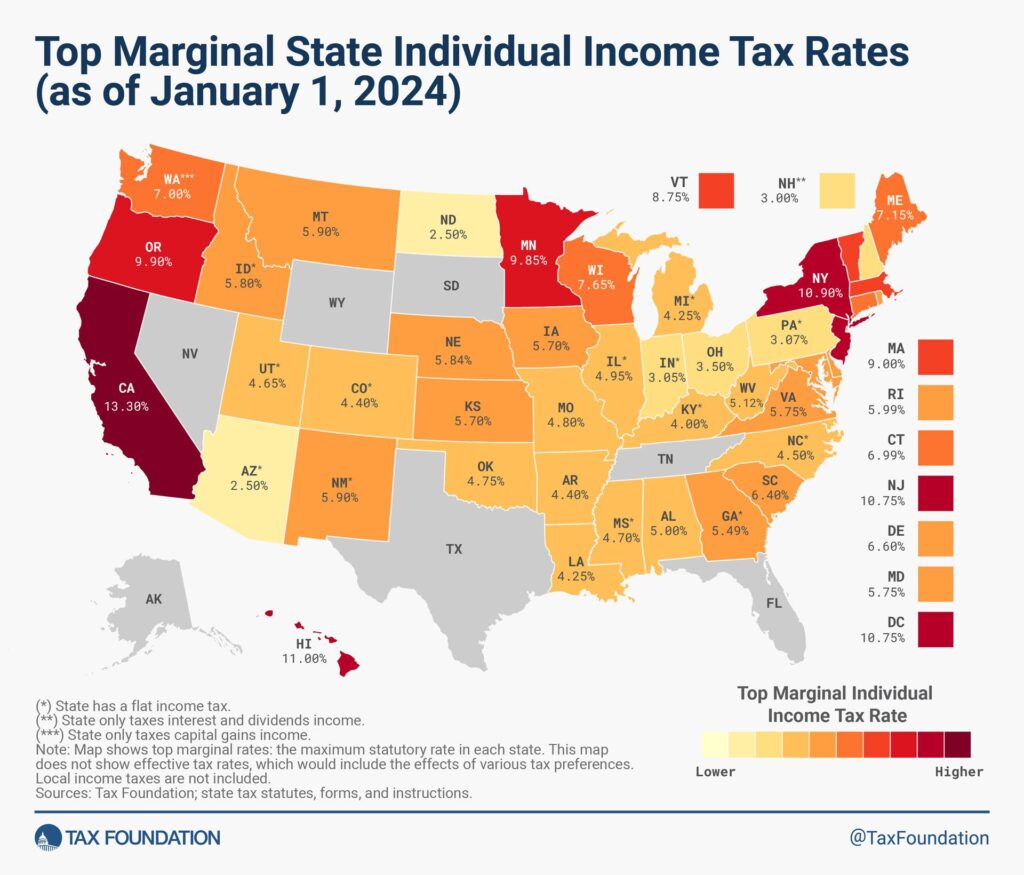
North Carolina currently applies a flat 4.5% state income tax rate to all taxable income, with filing requirements based on residency, income level, and deductions.
The income tax cap of 3.5% will take effect for taxable years beginning on or after January 1, 2027, once election results are officially certified by the North Carolina Board of Elections.
This amendment will lower the North Carolina Constitution’s maximum allowable state income tax rate from 7% to 3.5%. Therefore, the state government will be prohibited from increasing the state income tax rate above 3.5% without voter approval or another constitutional amendment contradicting this one.
The amendment was introduced by state Sen. Michael V. Lee (R-7) on May 13, 2026. In the North Carolina State Senate, the amendment was approved by a vote of 30-18. In the North Carolina House of Representatives, the amendment was approved by a vote of 73-46. Votes in both chambers were along party lines, with Republicans supporting the amendment and Democrats opposing it.
Republicans argue that the amendment would draw more businesses into the state and, therefore, put more jobs into the North Carolina job market. The argument basically plays into the fact that capping the income tax would promote economic competitiveness by competing with other states with lower rates. For example, NC has a flat rate of 3.99% for all filers, regardless of income or filing status while states like Indiana and Pennsylvania have rates of 3.05% and 3.07% respectively. These rates also coincidentally have higher or similar gross domestic product outputs per capita than NC at $542.5 billion and $976.36 billion respectively. NC’s GDP in 2025 was $895.9 billion but, even though it’s higher than Indiana’s, comparing the states of Indiana and NC’s populations of 10.83 million and 6.86 million residents respectively, the GDPs are actually similar, so the argument still stands.
Democrats argue that, since the state constitution already limits the maximum income tax rate, this new, even lower income tax cap would lock in tax breaks for corporations. It would also block future lawmakers from fair revenue options when needed.
Property Tax Limit Amendment
The property tax limit got a narrower 60.42% voter approval rating (2,463,634 for and 1,613,938 against) with mixed numbers regionally.
This isn’t the first time voters chose to do so. In 2018, more than 57% of voters agreed to amend the constitution to cap income taxes at 7%.
This amendment Requires the General Assembly to enact laws limiting increases in property-tax levies by local governments. The amendment does not establish the limits or formulas; those would be determined through subsequent legislation, which may include exceptions.
It’s worth noting that there is no state property tax in North Carolina. Instead, local governments set property tax rates and collect funds to provide services like waste management, public safety, K-12 school facilities, teacher salary supplements, and recreation. This constitutional amendment would give the state legislature the power to set a limit on the ability of local governments to increase property taxes by creating a levy limit.
Also, in North Carolina, counties cannot levy income taxes, so property taxes are the primary source of local government revenue for services such as public schools, law enforcement, libraries, water and sewer systems, and other municipal functions. According to the NC Budget and Tax Center, in most counties in North Carolina, property taxes account for over half of the General Fund budget, with Jackson County reportedly being one of those counties.
The amendment does not define a specific cap on property taxes. State lawmakers will determine that later.
An existing state law limits property tax rates to no more than $1.50 per $100 of appraised value. County rates currently range from 22.2 cents to 93 cents.
SAVE Act or Photo ID Amendment (federal)
This amendment passed with majority support statewide similar to the income tax amendment with a 60% voter approval rating (2,434,689 for and 1,650,343 against).
This was the only federal amendment on the ballot for the NC general elections. The amendment passed the House in February 2026 with a 218-213 vote and is strongly supported by the Trump Administration.
According to the Pew Research Center, 83% of Americans favor requiring all voters to show government-issued photo ID to vote, including 95% of Republicans and 71% of Democrats. 16% of Americans are in opposition.
The Safeguard American Voter Eligibility Act or the SAVE Actis federal bill that will require proof of citizenship for voter registration for federal elections, usually by requiring documentary evidence like U.S. passport, birth certificate, real ID, naturalization certificate or certificate of citizenship, etc. This amendment would also alter the language of the current voter ID law to require absentee mail-in ballot voters to present photo identification – as in-person voters do.
Proponents of voter ID laws (mainly republicans) contend that the amendment will guard against voter fraud, while opponents (mostly democrats) maintain that the amendment will disenfranchise low-income and minority voters.
Under current federal law, states use a variety of registration systems, including online registration, registration through motor vehicle agencies, automatic voter registration, mail registration, and community-based registration drives. The SAVE Act will disrupt all of these systems and even eliminate some of them depending on separate legislation.