A version of this story was published in The Sylva Herald
At the Board of Commissioners work session Tuesday night, Jackson County Sheriff Doug Farmer gave a presentation on the JCSO’s use of Flock cameras, aiming to answer residents’ questions and address what he called misconceptions.
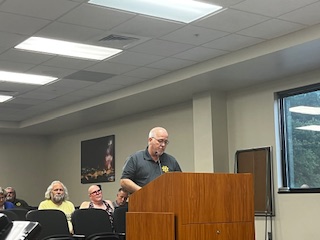
During the meeting, Farmer discussed what Flock cameras are and are not, when the cameras are used and a brief overview of the policy.
Flock cameras are automated license plate readers owned by Flock Safety, a public safety technology company that provides technology including the license plate readers, drones, video cameras and gunshot detectors to law enforcement agencies.
ALPRs are computer-controlled camera systems usually mounted on street poles, streetlights or highway overpasses, according to the Electronic Frontier Foundation. Mobile ALPRs can be attached to police patrol cars and capture data, or on speed trailers.
When a vehicle passes the camera, it captures an image of the vehicle’s license plate, including the location, date and time. According to EFF, sometimes the photograph of the vehicle can include its driver and passenger.
This information is then uploaded to a central server and can be shared regionally or nationally.
During the meeting, Farmer said Jackson County only has four Flock cameras, two on state right-of-way and two on private property. Later, Board Chair Mark Letson asked about Flock cameras on the back of any speed trailers.
“We may have one or two,” responded Farmer, clarifying that Flock cameras can’t be used to enforce traffic violations.
According to DeFlock.org, an open-source project that maps ALPRs using crowd-sourced data, there are nine ALPRs in Jackson County, not including Verkada cameras in Cherokee. Not all of these are necessarily owned by the Sheriff’s Office.
Using the database, there are two cameras at the Lowe’s across from Smoky Mountain High School. Lowe’s itself has a contract with Flock. One camera is at E.J. Whitmire Stadium at Western Carolina University. There is one camera on the Great Smoky Mountain Expressway, two in Cashiers and one across from Rockhound Ridge Gem Mine. There are two ALPRs in Dillsboro next to the Dillsboro Post Office that cover a stretch of Haywood Road.
Farmer told the commissioners that out of 82 employees, only 17 have access to the system and the majority of that only has user access, granting them the ability to search the system and create a hotlist.
He said the JCSO has a retention period of 30 days after which the data is deleted. He also said there has been no reported misuse within the department and that the department maintains audit logs, conducting routine audits to maintain the integrity of ALPR usage.
In his presentation, Farmer cited three court cases to say that Federal and State courts overwhelmingly rule that using ALPRs on public roads does not violate the Fourth Amendment.
Farmer said the department uses the cameras for BOLOs or “Be On the Lookout” notifications, missing persons, Silver Alerts, Amber Alerts, kidnappings, wanted persons, stolen vehicles, criminal investigations, human trafficking investigations and health and welfare checks.
Farmer first presented a contract with Flock to the Board of Commissioners in 2024. The contract he presented would last for five years and cost over $55,000, payable by yearly budget.
“These are strictly for Silver Alerts,” Farmer told the commissioners during the 2024 meeting, before telling them about an investigation that was solved with the cameras. Silver Alerts pertain to missing seniors and vulnerable adults.
According to the approved budget for fiscal year 2025-2026, a total of $1,514,000 was allocated for the equipment section of Capital and Capital investments, a category which included Flock cameras among other equipment. For fiscal year 2026-2027, it was $1,318,543.
During Tuesday’s meeting, Director of Finance Darlene Fox told commissioners the Flock cameras are in Farmer’s allocated budget.
Farmer emphasized that enforcement actions cannot be made solely based upon ALPR images and that probable cause or at least reasonable suspicion must be established.
From June 30 to July 30, JCSO Flock cameras had 1.19 million reads, 563 searches and 4,652 hotlist hits, according to Farmer’s presentation.
JCSO shares Flock camera data with 280 agencies within the state, Farmer said.
Secrecy
The commissioners heard Farmer’s take on the cameras, but there is still information The Sylva Herald has asked for and not received.
The Sheriff’s Office did not respond to multiple emails and phone calls from The Sylva Herald to discuss Flock.
When asked in person for an interview, Farmer refused.
Farmer did not answer the Herald’s questions about which agencies the data is being shared with, arrest statistics, whether the contract has changed since 2024 or additional details about the Flock cameras owned by JCSO.
The Sylva Herald is waiting to hear back after sending a public records request asking for this information as well as an audit of searches performed within the department’s own Flock organization and audit of searches of JCSO’s system by other agencies.
The Herald will keep pressing for the information so the public can be more aware of how Flock cameras and other surveillance technologies are tracking Jackson County residents and others.
See related story: Flock, other ALPRs face rising concerns over misuse, privacy