Story re-published from The Sylva Herald, Sept. 30
Budget, housing, transportation, food, data centers and flock cameras were topics that five candidates for county commissioners answered during the only public forum this mid-term elections.
Organized by Southwestern Community College students in the Introduction to Sociology class young voters researched and asked questions in a room full of community members who wanted to hear what the candidates had to say.
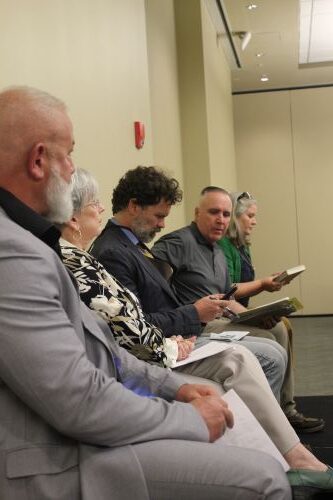
The only incumbent commissioner, John Smith (R), representing District 2, was not present on the stage. The organizers had the candidates draw a paper to determine the order in which they will answer students’ questions and rotate the order. After a short speech from SCC president Don Thomas, student started with their questions.
Why are they running
Casey Walawender, running for a commissioner in District 1, described herself as a first generation WCU graduate, a social worker who worked in the county public school, volunteer in the food pantries who cares for the community. She decided to run when she saw that the present commissioners were not listening to the community.
“I never thought I’d be a politician, but I do have a long line of kind of community service. And so it did feel like a natural progression for to step up and serve my community,” Walawender said.
David Rodgers, who is running for chairman of the county commission got off the stage to talk to the audience adding he is not a “speaker” and wanted to be at their level. Rogers is a long time resident of the county who works as a coach and has his own automobile business. He said he wanted to run for office 15 years ago, but his employers at the time said he would have conflict of interest.
“I am not a politician. I am somebody that is out here to help everybody in this county,” Rogers said.
Steven Sutton, a former county police officer and highway patrolman, is running against Walawender. He said that his main reason for running are the taxes and people struggling financially.
Sean Bridges, candidate for commissioner in District 2, said that the library issue helped him make the decision to run for office.
“The reason the library was attacked, I felt, was for bigoted reasons,” he said. “Prejudices that people have. People have prejudices. Okay, that’s fine, but you can’t base the decision that affects 40,000 people on your personal opinion or even your religious beliefs.” Bridges said.
He added that the commissioners are wasting time and money and leaving people struggling and this is a way for him to do “something useful” for the place he loves. Bridgers is an actor, born and raised here.
Marcia Almond, underlined her previous experience in nursing, a mayor of Forest Hills and board position at the Southwestern Commission as a good base for her running for county chairperson.
“I decided to run for chairman because I feel like the current leadership has taken us in the wrong direction,” Almond said.
Budget
The students asked about the budget and if elected what would be their priority. All of the candidates agreed that the county budget is very high.
Sutton said that the budget grew over 50% in the last five years from $71.7 million to $108 million. He added that as commission they can’t do much on the property tax since they don’t control it, but for him priority is staffing at the Sheriff’s Office.
Rogers said the budget is inflated and he noticed that certain items were on the budget “four and five times the past four and five years.” He promised to cut the budget as his priority but did not specifically say where. He underlined that the current commissioners, all from his party, do not spend enough time on the budget and approve of everything proposed. As a chair of the commission Rogers wants to do something that Haywood is doing – go on a retreat and work on the budget for four to five days.
The Democratic candidates agreed that the budget is large.
Bridgers will prioritize needs not the wants and among the most important is increasing the salaries for JCSO personnel and teachers. Almond discussed the fact that the county spent $8 million on a property to build a middle school without doing a due diligence and now we are “sitting” on expensive rocks. She is proposing to invest in the existing schools and make them best for the kids. Walawender was all for cutting the budget but to do it with a plan looking forward, not haphazardly. She also added that the county does control the property tax.
“As a county [we] have the ability to adjust our property rates. That is not something the state does. That’s something we get to do. And this Republican led board, by not addressing the property rate, has essentially raised our taxes more than any board of commissioners in recent history in Jackson County,” Walawender said.
Transportation
The candidates differ in their take on county transportation system. Rogers and Sutton said that what Jackson Trolly is doing now is working fine. Rogers said that we spend too much on the service and we should be looking for a way to cut expenses.
Democratic candidates suggest expending and improving the service will be good considering the rising costs of gas and people needing to use it to go to work. Almond suggested establishing regular hours and bus stops that will help people get to places and use the system to travel to Cashiers, the casino or use it at night. Bridger wanted services like Lyft or Uber to be allowed in the county adding that it could be good for all.
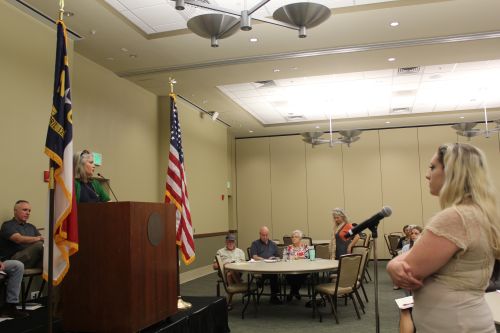
“I say Uber should be allowed here,” Bridgers said and the audience approved with applause.
Walawender added that we need to consider the aging population in the county and it’s “going to get more and more difficult for them to drive and get to their doctor’s appointments.”
“I think we all agree, all of us, that the transportation system needs to expand and that the county needs to be committed to that,” Walawender said. She also said that the fact that students from Swain having to pay for the bus to take them to Early College in Sylva is not right. This should be a free service as an investment in education.
Rodgers did not agree with the idea for expansion.
“I’m glad I got to go last. I apologize, but I don’t agree with you. I do not think we need to expand transportation. Here’s why. 37% increase in county spending for that service this past year. Does anybody have any idea what kind of money that meant to this county? 1.2 million,” Rogers said. “What that tells me is I’ve got constituents who can’t even afford their taxes. And I’m telling them, a kid getting to school or somebody going to casino to drink, or going somewhere to gamble or going to somebody’s house and drink a beer and can’t drive home, is more important than them paying for their house.”
Rodgers said that he cares for transportation. “I am willing to make everything I can do to make it better, but I will not spend a dime on it,” he added.
Housing and renting
All candidates agreed that hosing and renting in the county is a problem, but it’s a national problem. As a county they cannot cap the rent nor force people not to do short term renting. However, they all mentioned investments in affordable housing like Webster Village that will build 220 houses and the renewed proposal for affordable housing in Cashiers, Vision Cashiers. Almond proposed county to “adopt a short term rental ordinance that is similar to the one adopted by the town of Sylva.”
“I will establish a county housing committee that where we buy and renovate existing structures and sell or rent them at a minimal profit, where we establish safety regulations for landlords so that they don’t become slumlords,” Almond said.
Walawender discussed private public partnerships to address the lack of housing in the county as something that will ensure people staying and paying taxes in the county rather then, working her and living somewhere else.
“When I talk about this planning ahead, it’s not something we’re going to take care in one or two years,” Walawender said.
Rogers proposed cutting the budget and the taxes first and reaching out to local construction companies to see what can be done.
SNAP and access to food
Student quoted data from Feeding America that over 17% of Jackson County is food insecure and only 12.1% receive Supplemental Nutrition Assistance Program benefits asked what they will do to support the people who are food insecure but don’t get SNAP benefits.
Walawender was first, and she started by praising the county commission for paying for free food in the county school system. She said that this decision made a lot of difference in the last two years and it is a half a million-dollar good investment.
“We need to support those kids as the federal government is making cuts to SNAP. That burden is going to fall on counties,” she said adding that according to census data Jackson has “the hungriest kids in the western part of the state.”
Walawender also said that the food pantries and the county need to support and provide the resources these organizations need because she is seeing that more people will need them.
Rodgers listed Department of Aging providing support for food deliveries for the older populations, 35 to 40 local churches that serve meals and providing food, as well as the United Christian Ministries and Community Table on top of the free school lunches. He added that commissioners also need to pay more oversite and prevent embezzlement like what happened earlier this year with HERE funding.
Bridgers corrected him by clarifying that this case was for housing for homeless not connected to the organizations providing food services. He also said that the county needs to start thinking about securing place for Community Table because eventually they will need new space and the need for their services is going to be increasing.
Data Centers and Flock Cameras
These two questions were the only ones where all candidates speaking at the forum said are not needed in the county. They praised the one-year moratorium on data centers and continue to monitor the situation to avoid any surprises.
Rogers added that with the development of technology the commissioners need to re-evaluate, and if the technology improves and the impact on the environment and resources is less to look at the issue again. Almond said that the county geography makes it hard to find a space to build a school let alone to have a big data center. For Bridges this is a hard no topic because its not worth the money to destroy what we have now.
“We’ve got to protect what we’ve got because in the long run we can sustain this. If we’re smart. We’ve got everything we need,” Bridges said.
Similarly, on the topic of the Flock cameras the candidates all said that they are more liability than benefit. Sutton, as a former police office said he was for them at the beginning but after seeing how they can be abused changed his opinion on them. [See more on flock cameras in the county. ]
“We have a $1.3 million budget for Flock cameras. We also have a sheriff who asked for $930,000 in raises for his deputies. I suggest we take that $1.32 million and give it to our deputies,” Almond proposed.
When the event ended the candidates continued to mingle with the community who were eager to meet and ask their own questions.